
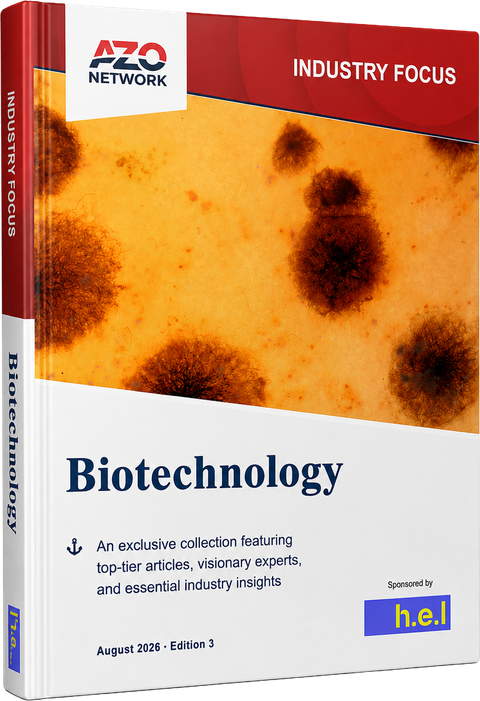
Free eBook · Industry Focus: Biotechnology · August 2026
Inside the lab where robots take the samples and fermentations run for seven days
At TU Berlin’s KIWI-biolab, a BioXplorer 100 sits at the centre of a fully automated bioprocess platform — robotic sampling, automated analytics, and continuous fermentations of up to seven days with minimal manual intervention. This eBook shows how they built it, and what it changed.
Sponsored by H.E.L Group. Featuring peer-reviewed work from TU Berlin, Wageningen University and the Van Andel Institute.
- Building an automated platform for bioprocess development and downstream analytics
- Running the BioXplorer 100 as a turbidostat for high-density E. coli cultivation
- Pressure-enhanced oxygen transfer in aerobic fermentation
Download the eBook
Nine articles on automated bioprocessing, fermentation control and scale-up. Free.
Your download link appears on the next page.
Three technical case studies from H.E.L
Written by the H.E.L applications team, each built on real cultivation data rather than specification sheets.
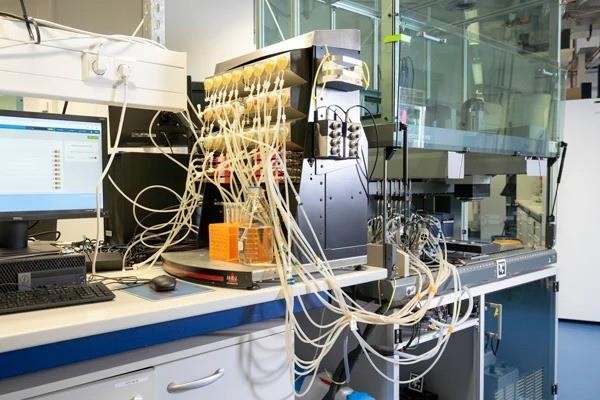 Image credit: H.E.L Group
Building an automated bioprocess platform at TU Berlin
How the KIWI-biolab made the BioXplorer 100 the operational core of a self-running facility — integrated with a Tecan Freedom Evo 150 liquid handler, the mobile robot MiLA, Cedex Bio HT and two-dimensional HPLC QTOF. Continuous fermentations up to seven days, cultivating Pichia pastoris and E. coli for vaccine antigens, antibodies and enzyme synthesis.
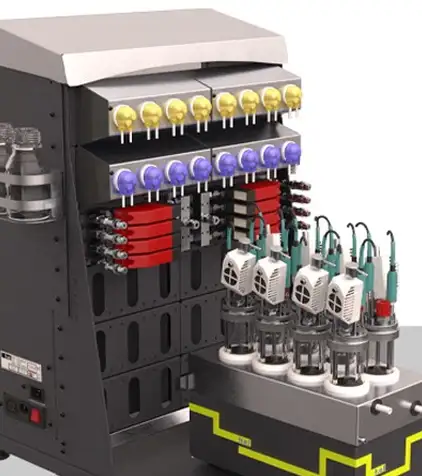
Turbidostat control for high-density E. coli cultivation
Holding a culture at constant cell density by feeding turbidity back into the medium inflow in real time. Uses the integrated BioVIS probe and WinISO-controlled pumping, including how to correlate probe output with cell density at high biomass where optical methods normally break down.
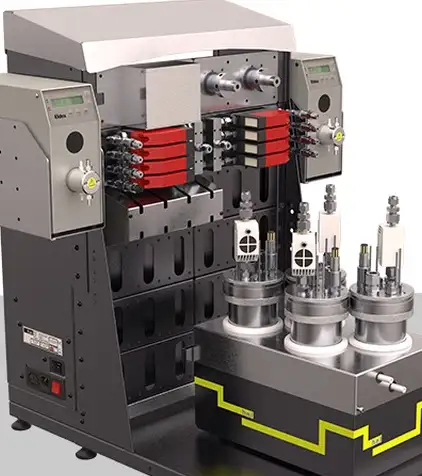
Pressure-enhanced oxygen transfer in aerobic fermentation
Oxygen transfer is the hard limit on cell growth and productivity in aerobic work. This quantifies what raising pressure does to dissolved oxygen and kLa on the BioXplorer 400P — and why more bioprocess groups are moving to pressurised systems for gas-dependent work.
And six independent research articles
Curated by AZoNetwork’s editorial team, not by us.
- A CRISPR tool that cuts tumour DNA and spares healthy cells — ThermoCas9 reads DNA methylation as an address. Published in Nature, from Wageningen University and the Van Andel Institute.
- Emerging nanoplatforms in biopharma — lipid nanoparticles, exosomes and smart nanocarriers for targeted delivery.
- Sensor technologies in personalised biopharma — the move toward responsive, individualised therapeutic strategies.
- CRISPR gene-drive reverses antibiotic resistance in bacteria — tackling one of healthcare’s most pressing problems.
- Bifunctional biomaterials for postoperative osteosarcoma management — materials that treat as well as rebuild.
- An eco-friendly laser made entirely from biomaterials — sustainable photonics from natural materials.
Who it’s for
Bioprocess development scientists
Running fed-batch, chemostat, turbidostat or perfusion cultures and losing days to manual sampling.
Fermentation engineers
Hitting oxygen transfer limits and wondering whether pressure is the answer.
Automation and lab digitalisation leads
Planning an integrated platform and wanting a worked example rather than a vendor promise.
Academic research groups
Building high-throughput capability on a budget, with equipment that adapts as the research changes.
Nine articles on automated bioprocessing, gene editing and biomaterials — free to download.