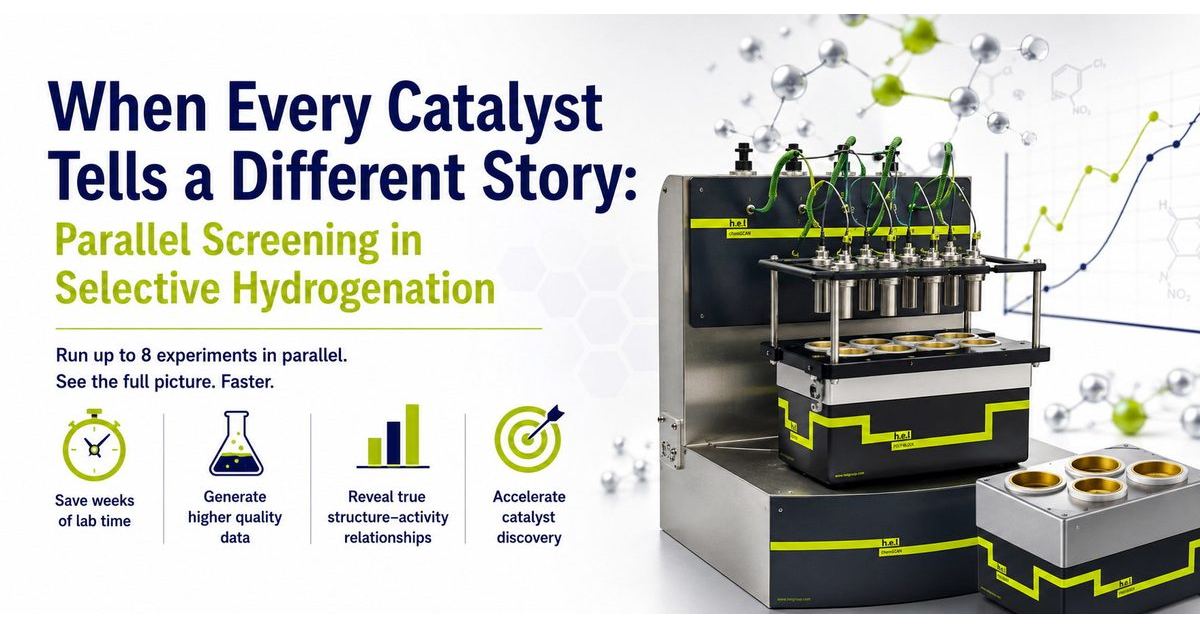
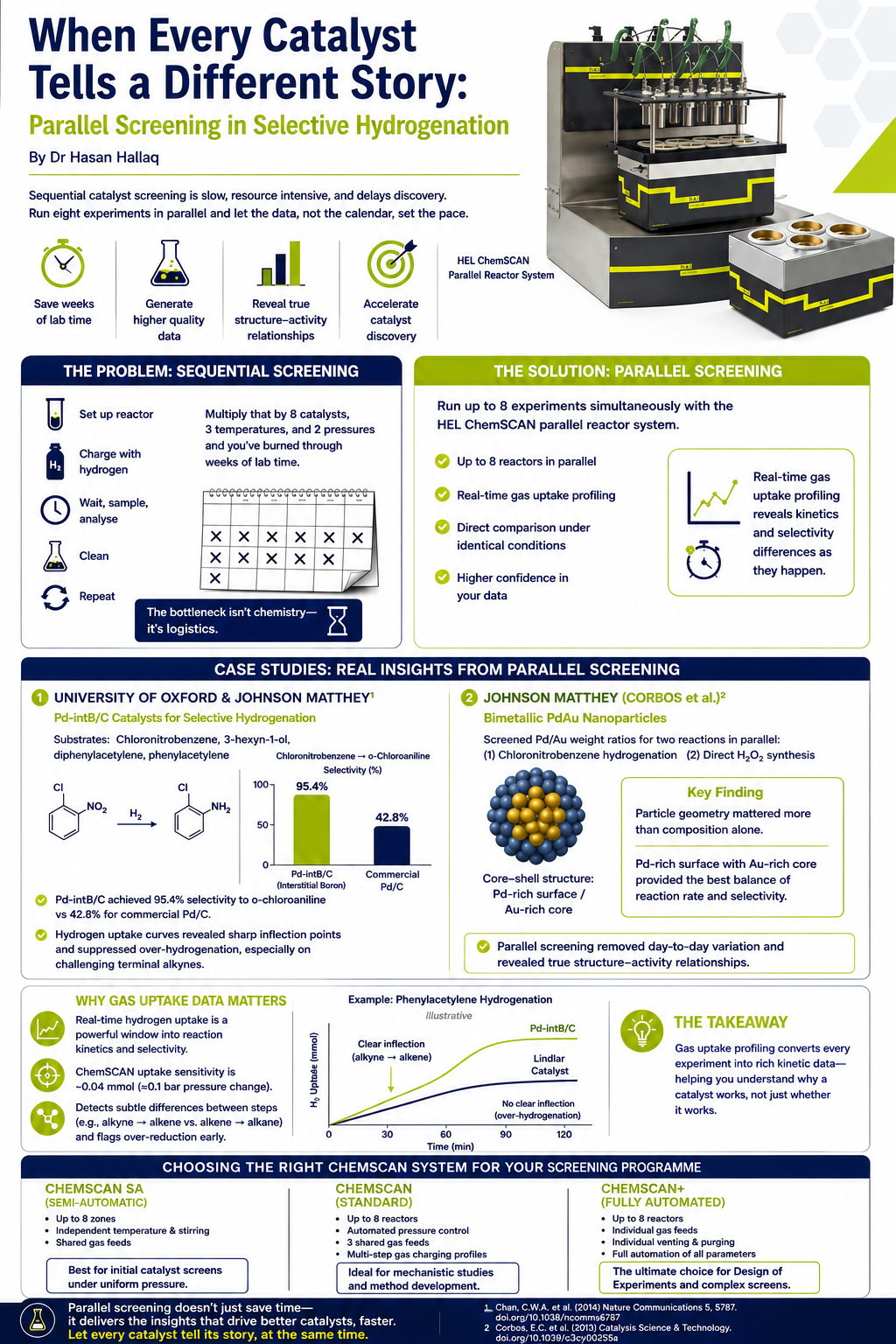
There is a moment in every catalysis project where you realize you have been running experiments one at a time for far too long. You set up a reactor, load your substrate, charge it with hydrogen, wait, sample, analyze, clean, and repeat. Multiply that by eight catalysts, three temperatures and two pressures, and you have burned through weeks of lab time before you even begin to see a pattern.
That is the reality for anyone working in selective hydrogenation, where the difference between the product you want and the one you do not can come down to a single variable you never got around to testing.
The problem with sequential catalyst screening
Selective partial hydrogenation is one of the most commercially important transformations in fine chemical and pharmaceutical synthesis. Whether you are reducing a nitro group while preserving an aryl halide bond, or saturating an alkyne to a cis-alkene without overshooting to the alkane, the challenge is the same. Your catalyst, your pressure, your temperature and even your solvent all have opinions about what the product should be, and those opinions often conflict with yours.
Traditional single-reactor screening creates a bottleneck that has nothing to do with chemistry and everything to do with logistics. When each experiment takes the better part of a day, and you need dozens of data points to map out the selectivity landscape, the calendar becomes the rate-limiting step rather than the kinetics.
What changes when you run eight experiments in parallel
Researchers at the University of Oxford, working alongside Johnson Matthey, faced exactly this challenge when they developed a new class of palladium catalyst modified with interstitial boron atoms for selective hydrogenation. Their work, published in Nature Communications, aimed to create a greener alternative to Lindlar catalysts — those widely used but problematic systems that rely on toxic lead additives.1
To evaluate their Pd-intB/C catalysts against conventional Pd/C and Lindlar catalysts across multiple substrates, they used the H.E.L ChemSCAN parallel reactor system. Running hydrogenations of chloronitrobenzene, 3-hexyn-1-ol, diphenylacetylene and phenylacetylene under controlled pressure and temperature, they were able to monitor real-time hydrogen uptake curves for each reaction in parallel. The hydrogen uptake profiling was not just a convenience — it was the primary analytical method that revealed the dramatic selectivity differences between catalysts. The Pd-intB/C system achieved 95.4% selectivity to ortho-chloroaniline in the chloronitrobenzene reduction, compared with just 42.8% for a commercial Pd/C, and that distinction was visible directly in the uptake data.
In a separate study at Johnson Matthey, Corbos and colleagues used the same ChemSCAN platform to screen bimetallic PdAu nanoparticles of varying composition for both chloronitrobenzene hydrogenation and direct hydrogen peroxide synthesis.2 By preparing catalysts with Pd/Au weight ratios of 75/25, 50/50 and 10/90 and testing them all simultaneously, they discovered that the geometry of the bimetallic particles mattered more than the composition alone. Particles with a palladium-rich surface and a gold-rich core gave the best compromise of reaction rate and selectivity. That kind of structure–activity insight is nearly impossible to extract from sequential experiments, where day-to-day variation in setup introduces confounding variables.
Why gas uptake data matters more than you might think
One of the underappreciated capabilities of a properly instrumented parallel reactor system is its ability to calculate gas consumption in real time. On the ChemSCAN platform, uptake sensitivity reaches approximately 0.04 mmol of gas consumption, which corresponds to roughly a 0.1 bar pressure change. That resolution is enough to distinguish between the first and second hydrogenation of a disubstituted alkyne, or to spot the onset of over-reduction before it runs away.
In the Oxford study, the hydrogen uptake curves were the key evidence that the boron-modified catalyst suppressed over-hydrogenation. The inflection point where the rate changes, corresponding to the transition from alkyne to alkene hydrogenation, was sharply defined for the Pd-intB/C catalyst but absent for Lindlar catalysts on challenging terminal alkynes like phenylacetylene. That observation, repeated across multiple substrates in the same experimental run, made the case for interstitial modification far more convincingly than any single experiment could have.
Choosing the right level of automation for your screening program
Not every laboratory needs the same level of parallel control, and the ChemSCAN family is designed to reflect that. The ChemSCAN SA provides semi-automatic control across up to eight zones, with independent temperature and stirring but shared gas feeds. It is well suited to initial catalyst screens where you want to compare performance under uniform pressure conditions. The standard ChemSCAN adds automated pressure control and three shared gas feeds, allowing you to build multi-step gas charging profiles that reveal mechanistic detail. And the ChemSCAN+ takes independence to the reactor level, with individual gas feeds, individual venting and purging, and full automation of every parameter. That makes it the tool of choice for Design of Experiments programs where each reactor truly runs its own protocol.
For a team like the one at Oxford, where different substrates with very different reactivities were being tested simultaneously, the independent control of the ChemSCAN+ architecture would allow each vessel to operate under its own optimized conditions rather than a single compromise. For the Johnson Matthey team screening catalyst compositions under identical conditions, the shared gas-line architecture of the standard ChemSCAN was exactly the right level of complexity.
The broader picture for catalysis R&D
The shift toward parallel experimentation in catalysis is not just about speed. It is about the quality of the comparisons you can make. When eight catalysts are tested in the same thermal block, under the same gas supply, at the same moment in time, the differences you observe are genuinely attributable to the catalyst rather than to experimental drift. That reproducibility is what makes the data publishable and, more importantly, what makes the conclusions trustworthy enough to base a scale-up decision on.
Related reading
Catalysis accelerated: how the H.E.L ChemSCAN is revolutionizing high-pressure research
Why supported catalyst screening systems matter more than ever in 2026
Hydrogenation: how we can make it safer
Frequently asked questions
What reactor volumes are available for hydrogenation screening on the ChemSCAN?
The platform supports vessels from 16 mL up to 500 mL in stainless steel or Hastelloy construction. The smaller 16 and 25 mL vessels are available on both four-zone and eight-zone configurations, while the larger 75, 125, 300 and 500 mL vessels are available on the four-zone systems. This lets you start with milligram-scale screens and move to gram-scale evaluations on the same platform.
Can the ChemSCAN handle the pressures needed for typical catalytic hydrogenation?
Yes. The system operates up to 100 bar as standard, with an optional rating to 200 bar. Most pharmaceutical and fine chemical hydrogenations run between 1 and 50 bar, so the platform provides substantial headroom for high-pressure catalyst studies, syngas work and carbonylation chemistry.
How does gas uptake measurement work on the ChemSCAN?
The software monitors pressure in each reactor zone and calculates gas consumed during user-defined reaction stages. With an uptake sensitivity of approximately 0.04 mmol per 0.1 bar pressure change, you can track reaction progress, identify selectivity transitions and compare catalyst activities in real time without the need for offline sampling.
What distinguishes the ChemSCAN from the ChemSCAN+ for hydrogenation work?
The main difference is gas feed independence. On the standard ChemSCAN, gas feeds are shared across all reactor zones, which is ideal when you want identical conditions and are varying the catalyst or substrate. On the ChemSCAN+, each reactor has its own independently controlled gas feeds (up to three per zone), allowing you to test different gas compositions, pressures or mixed-gas strategies across reactors simultaneously.
Is the ChemSCAN suitable for air-sensitive catalyst screening?
The system can be purged with inert gas before use, and the sealed reactor architecture allows you to work under an inert blanket. For highly sensitive catalysts, the platform can be loaded and sealed inside a glovebox before being connected to the gas manifold. The Hastelloy vessel option also provides corrosion resistance for aggressive substrates or products.
Can I integrate the ChemSCAN with an analytical instrument like a GC or HPLC?
Yes. The WinISO control software supports integration with third-party analytical equipment, including GC-MS and HPLC. You can trigger automated sampling and even build feedback control loops that adjust reaction conditions based on analytical results, which is particularly useful for optimizing selectivity in real time.
1. Chan, C.W.A. et al. (2014) “Interstitial modification of palladium nanoparticles with boron atoms as a green catalyst for selective hydrogenation.” Nature Communications, 5, 5787. doi.org/10.1038/ncomms6787
2. Corbos, E.C. et al. (2013) “Tuning the properties of PdAu bimetallic nanocatalysts for selective hydrogenation reactions.” Catalysis Science & Technology. doi.org/10.1039/c3cy00255a