
For decades, cutting carbon emissions has meant one thing above all: emit less. That’s still true, and it still matters. But a different question has been gaining traction in biotech circles over the past few years: what if CO₂ wasn’t waste at all, but a raw material?
It’s not a new idea in principle, but it’s no longer confined to academic papers. Labs and startups around the world are engineering microorganisms that can consume CO₂, CO, methane, and other one-carbon molecules and turn them into chemicals, fuels, plastics, food ingredients, and pharmaceuticals. Instead of building every product from fossil feedstocks, some manufacturers are starting to lean on biology to recycle carbon that’s already in circulation.
Carbon capture is only the first step
Industry and governments have poured billions into carbon capture over the last decade, largely with one goal: keep CO₂ out of the atmosphere. That’s worthwhile, but it leaves an obvious question unanswered: what happens to the carbon once you’ve captured it?
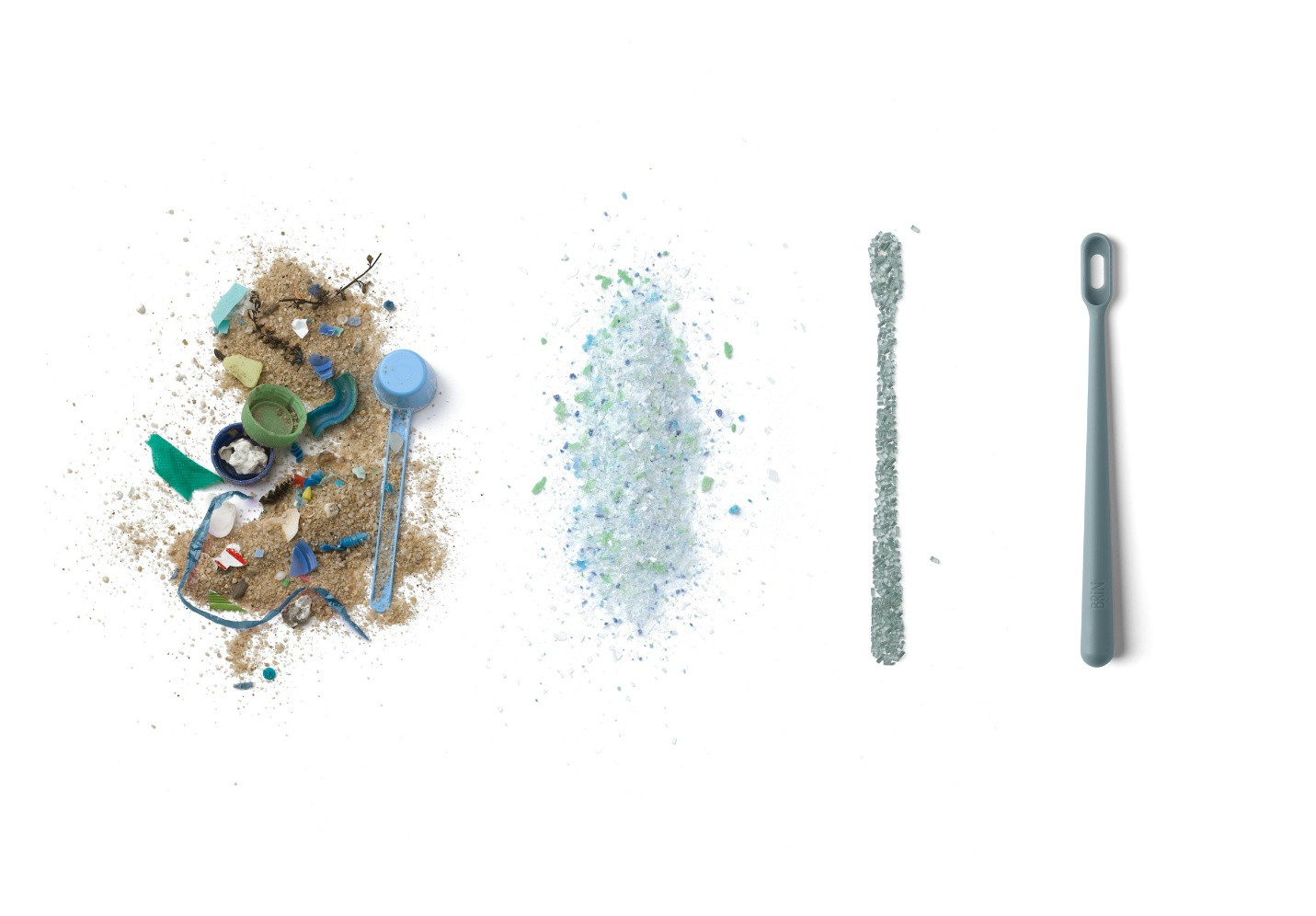
Storing it underground reduces emissions, sure, but it doesn’t generate any value. Converting it into something usable changes that math considerably, and this is where biology has started to earn a seat at the table1,2.
Some microbes are natural CO₂ or hydrogen feeders; others handle CO just fine. With synthetic biology, researchers are reworking these organisms to produce things like biodegradable plastics, aviation fuel precursors, and specialty chemicals, treating emissions as feedstock rather than exhaust. Recent reviews of the field point to steady progress in synthetic CO₂ bioconversion, driven by a combination of strain engineering, renewable electricity, and better reactor design. Together, these are pushing carbon-neutral, and in some cases carbon-negative, manufacturing closer to reality.
From smokestack to supply chain
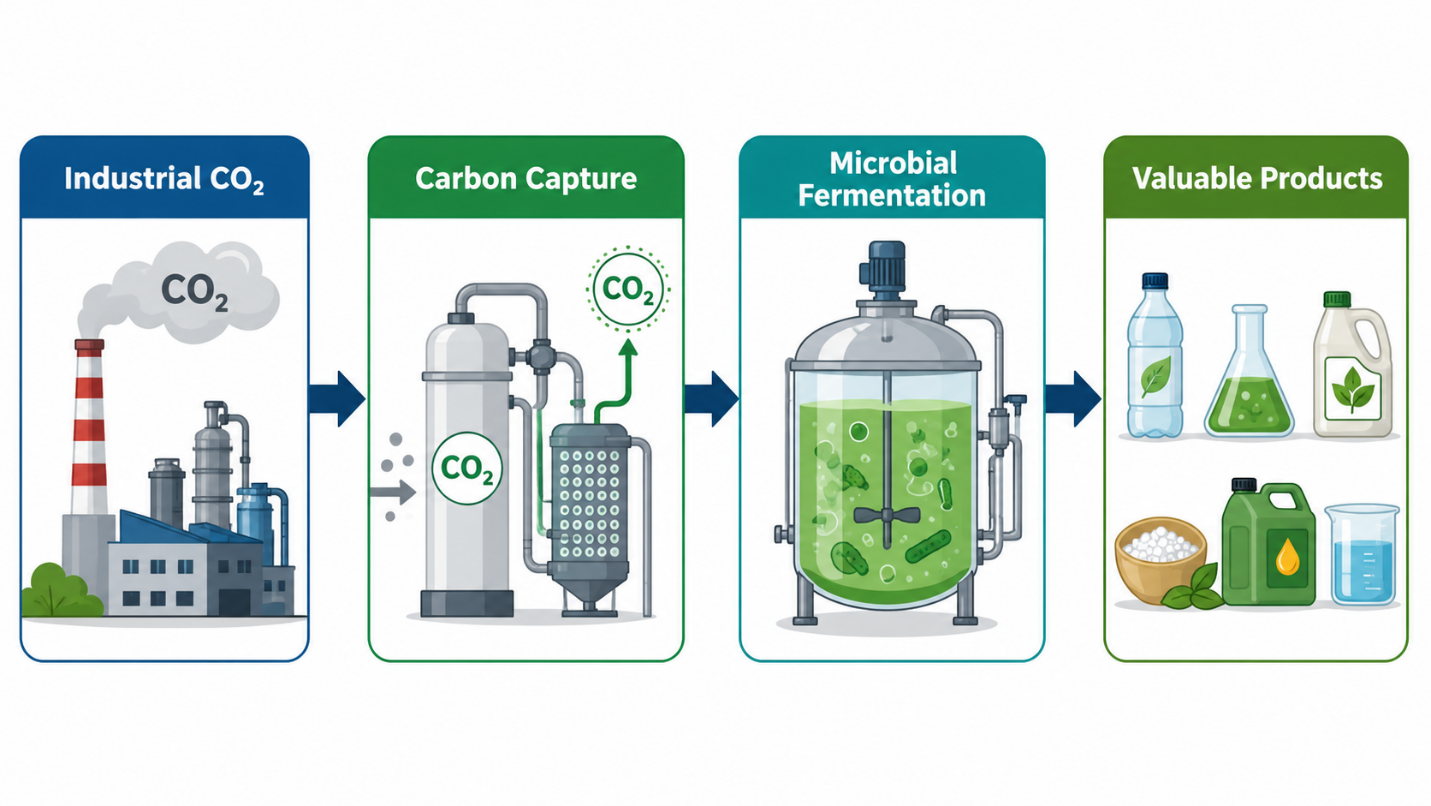
What makes this approach appealing is that it doesn’t require reinventing industrial infrastructure from scratch. Plenty of facilities already produce concentrated CO₂ streams. Rather than venting that gas, it could be piped into fermentation systems where microbes convert it into new products.
That’s the basic premise behind what’s often called a circular carbon economy. Thus replacing the old linear path of extract, manufacture, emit with something closer to capture, convert, manufacture, reuse.
The stakes go beyond climate policy. Industries built on petroleum-derived chemicals are under real pressure to cut emissions without slowing production, and biomanufacturing offers a way to work toward both at once. This isn’t a claim that biology will replace petrochemistry, but it’s a genuine second platform. One that can produce certain molecules more sustainably and chip away at fossil dependence where it makes sense.
Biology doesn’t just green up existing chemistry, it opens new routes entirely
There’s a common assumption that biotech is mostly about making greener versions of chemicals we already know how to synthesize. In practice, it often does something different: it opens manufacturing routes that traditional chemistry can’t touch easily.
Microbes can assemble complex molecules under mild conditions (no high heat, no high pressure) where the equivalent chemical synthesis would be energy-intensive or impractical. As synthetic biology matures, cells are being programmed to carry out increasingly elaborate metabolic tasks, and that’s a big part of why pharma, cosmetics, and food-ingredient companies are investing so heavily in microbial production.
There’s also growing interest in feedstocks beyond CO₂ itself, such as methanol, formate, acetate, and other one-carbon intermediates derived from captured emissions. These give manufacturers a way to move past agricultural sugars and sidestep the food-versus-fuel tension that’s dogged earlier generations of biofuels1,3.
The hard part usually isn’t engineering the microbe
Headlines love a newly engineered strain, and it’s tempting to think that once the genetics work, the rest is a formality. In reality, that’s often where the real work starts.
A strain that performs beautifully in a 250 mL shake flask can behave completely differently once it’s moved into a bioreactor. Gas transfer changes, mixing patterns change, oxygen availability shifts, nutrient gradients appear, and small environmental differences that seemed trivial at bench scale can swing productivity substantially.
This is especially true for carbon-utilizing organisms, since many of the gases involved are poorly soluble. Getting enough of them to the cells reliably means paying close attention to agitation, mass transfer, and the broader reactor environment. For these platforms, bioprocess optimization isn’t a downstream afterthought, but rather as central as the strain engineering itself.
Small gains add up fast
Commercial biomanufacturing rarely comes down to one breakthrough. More often it’s the accumulation of a lot of small wins: a better mixing regime, a steadier feed profile, tighter gas transfer, more consistent temperature and pH control. None of these look dramatic in isolation, but stacked together they can meaningfully change both productivity and cost.
That’s part of why parallel bioprocess development has become so useful. Testing conditions one at a time is slow, and it’s hard to build confidence in scale-up decisions from a handful of runs. Running multiple conditions side by side lets researchers cover more ground faster and generate richer datasets to work from.
Beyond carbon neutral
“Carbon neutral” has become a familiar target. However, carbon-negative manufacturing pushes further; the goal isn’t just to stop adding emissions, but to actively pull carbon out of the atmosphere and lock it into useful products.
Whether every application actually gets there is still an open question. Product lifetime, the energy sources involved, transportation, and end-of-life disposal all factor into the real carbon accounting, and that math won’t be the same for every process. Still, there’s a growing consensus that biological manufacturing has a real role to play in building a more circular carbon economy. Ideally by cutting reliance on virgin fossil carbon while turning captured emissions into something worth making4,5.
Where bioprocess development fits in
Getting a promising strain from the lab bench to a commercially viable process takes more than good genetics. Every new organism needs to be cultivated, characterized, optimized, and scaled, and that means understanding how agitation, dissolved oxygen, nutrient delivery, temperature, and gas transfer interact; all ideally before committing to a pilot-scale run.
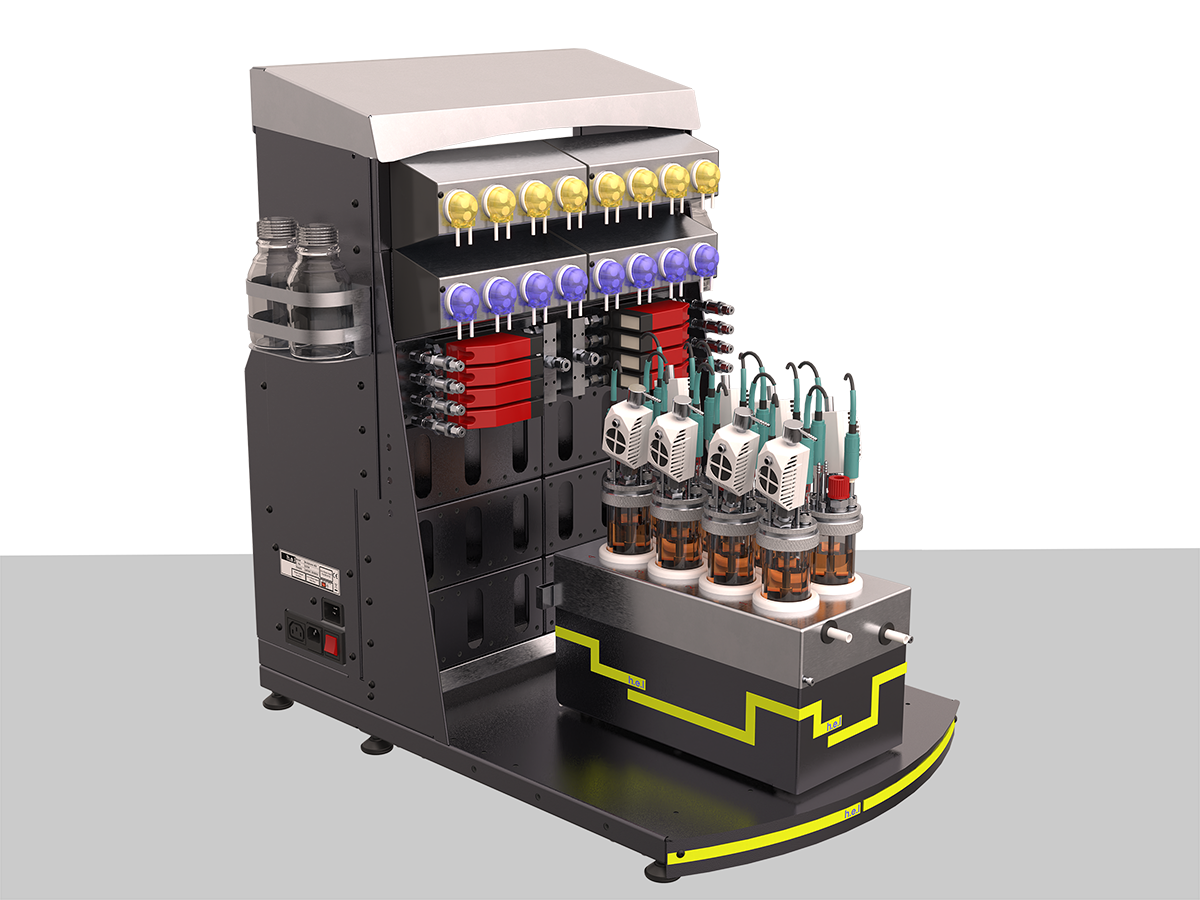
Parallel bioprocess platforms are well suited to that stage. Platforms such as the BioXplorer allow researchers to evaluate multiple gas transfer strategies, agitation parameters, and feeding profiles simultaneously. All of this combined accelerates optimization while generating higher quality scale up data. Being able to explore several cultivation strategies at once helps generate the process data needed to move climate-focused strains from an interesting result toward something that can actually be manufactured.
Looking ahead
Climate change is pushing every industry to rethink how things get made, and biotechnology offers something genuinely different: a way to turn an environmental liability into a manufacturing input. It won’t solve climate change on its own, and it shouldn’t be sold as if it could. But as synthetic biology, renewable energy, and bioprocess development continue to converge, making valuable products from captured carbon is looking less like a research curiosity and more like a viable manufacturing path.
The next generation of sustainable manufacturing may not start in a refinery. Turning captured carbon into valuable products will depend not only on better biology, but on better bioprocesses. As researchers advance promising strains towards industrial manufacture, the ability to optimize quickly and scale with confidence may prove just as important as the microbes themselves.
Curious how parallel bioprocess development is supporting this kind of work? Explore the BioXplorer range to see how researchers are accelerating fermentation and process optimization across industrial biotechnology applications.
Related reading
Innovative climate solutions: the role of bioreactors in carbon reduction
How can we feed the world and fight global warming? With microbes!
Achieving consistent oxygen transfer: the impact of kₗa on fermentation scale-up
Frequently asked questions
What is carbon-negative biomanufacturing, and how does it differ from carbon-neutral?
Carbon-neutral manufacturing balances the carbon it emits against the carbon it avoids or removes, so the net contribution to the atmosphere is zero. Carbon-negative manufacturing goes a step further: it removes more carbon than the process releases, locking captured CO₂ into a product rather than venting it. Whether a given process genuinely achieves this depends on the full life-cycle accounting — the energy source driving the process, transport, product lifetime and end-of-life disposal all count.
Which carbon feedstocks can engineered microbes actually use?
Beyond CO₂ itself, the practical feedstock list includes carbon monoxide, methane and a family of one-carbon intermediates derived from captured emissions — methanol, formate and acetate among them. Some organisms are natural CO₂ or hydrogen feeders; others handle CO well. Using these streams instead of agricultural sugars also sidesteps the food-versus-fuel tension that limited earlier generations of biofuels.
Why is gas transfer the main bottleneck in CO₂ and syngas fermentation?
The gases involved are poorly soluble in water, so the rate at which carbon reaches the cells — not the cells’ metabolic capacity — often limits productivity. That makes agitation, sparging and the resulting kₗa the variables that decide whether a strain performs. Raising headspace pressure is one of the most direct levers available, because gas solubility rises with partial pressure. It is also why a strain that looks excellent in a shake flask can disappoint in a bioreactor: the flask never tested the transfer regime.
How does running bioreactors in parallel speed up bioprocess development?
Testing conditions one at a time makes the calendar, rather than the biology, the rate-limiting step. Running several reactors simultaneously lets you vary feed profile, agitation, pH or gas composition side by side and compare the results within a single experimental batch, so the differences you see are attributable to the variable rather than to run-to-run drift. The BioXplorer 100 provides eight independent reactors at 50–150 mL working volume; the BioXplorer 400 provides four at 120–400 mL.
What equipment is needed to develop a gas-fed bioprocess?
For gas-dependent work the key capability is pressure. The BioXplorer 400P runs four parallel reactors at up to 10 bar and 0–135 °C specifically to raise gas solubility, with two sets of four mass flow controllers so each reactor can receive an independently controlled gas blend. For scale-up, the BioXplorer 5000 takes a single vessel from 1–5 L, also to 10 bar. Tandem off-gas analysis adds OUR, CPR and RQ, and BioVIS tracks cell density inline without sampling — both useful when carbon balance is the number you are chasing.
How do you tell whether a bioprocess is genuinely carbon-negative?
Only by doing the life-cycle accounting for that specific process. The carbon captured into the product is one term; the electricity and heat consumed, the source of any hydrogen used, feedstock transport and what happens to the product at end of life are all others. A durable material that locks carbon away for decades scores very differently from a fuel that is combusted within weeks, even if the fermentation step is identical. The honest position is that the biology is promising and the accounting has to be done case by case.
1. Zhao, C., Zhu, P., Chai, T., Zhang, J. & Chen, X. (2026) “Biological conversion of CO2 for bioproduction: beyond natural limitations.” Chemical Society Reviews, 55, 7487–7548. doi.org/10.1039/d5cs01228g
2. Tu, W. (2026) “Engineering electro-microbial routes for carbon-neutral biomanufacturing.” ACS ES&T Engineering, 6, 947–950. doi.org/10.1021/acsestengg.6c00119
3. Bachleitner, S., Erian, A.M., Mattanovich, D. & Ata, Ö. (2026) “Non-agricultural feedstocks for next-generation biomanufacturing with yeasts.” Current Opinion in Biotechnology, 99, 103509. doi.org/10.1016/j.copbio.2026.103509
4. Scown, C.D. (2022) “Prospects for carbon-negative biomanufacturing.” Trends in Biotechnology, 40, 1415–1424. doi.org/10.1016/j.tibtech.2022.09.004
5. Jofre, F.M., Prado, C.A., Shibukawa, V.P., Raymundo, M.T.F.R., Mendonça, T.A.P. & Chandel, A.K. (2026) “Biotechnological innovations in the realm of carbon capture, storage and utilization.” Frontiers in Climate, 8, 1805906. doi.org/10.3389/fclim.2026.1805906