Introduction
Turbidity is a widely used technique in which monitoring particles in a liquid can provide valuable insight into the system. In the case of crystallization, for example, it can accurately define the metastable zone width (MSZW), while for suspended solid mixtures, it can quantify the solid content over a wide concentration range.
However, turbidity probes cover a range of designs which can result in different performance depending on the specific application and the chemicals involved.
HEL produces turbidity probes that can work in one of two ways:
- Back scattering method, where light reflected by the solids is measured in comparison with `clean’ solvent.
- Transmission method, where a reflection `mirror’ is placed close to the end of the probe and we measure the decrease in reflected light picked up by the probe.
This report will look at two very different applications and compare the performance of the above HEL probe (and the two methods) with a Mettler Toledo turbidity probe (model Trb 8300), which works only in back-scatter mode
Measurements Of Suspended Solids
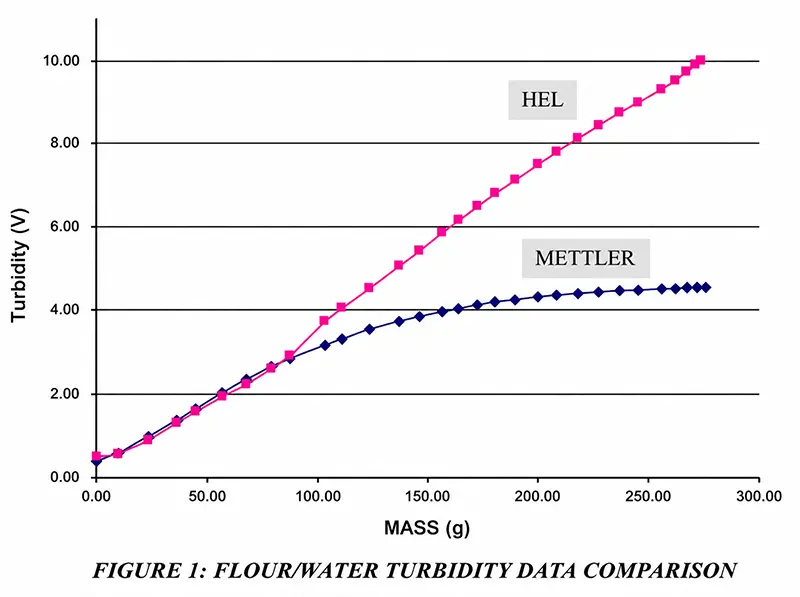
The response of the back-scatter probes to the addition of flour to 500 ml of water, in a stirred (~250 rpm) vessel, was compared. Ideally, the turbidity should increase linearly with solids loading.
The results are presented in Figure 1. This shows that the HEL and Mettler probes respond in an identical manner, with linear response to solids content initially.
However, at ~ 120 g/litre, the Mettler probe starts to curve noticeably. At loadings in excess of 200 g/litre, the probe did not respond to further addition of powder. This is in line with Mettler’s own documentation.
Crystallization Monitoring
Objective
A common application of turbidity is to measure the appearance and disappearance of crystals, as a solution is heated and cooled, allowing the so-called metastable zone width (MSZW) to be automatically estimated.
The sensitivity of the probes is important in this application so that the effect is detected as soon as the first crystals appear and as the last crystal dissolves.
Back-scattering Data
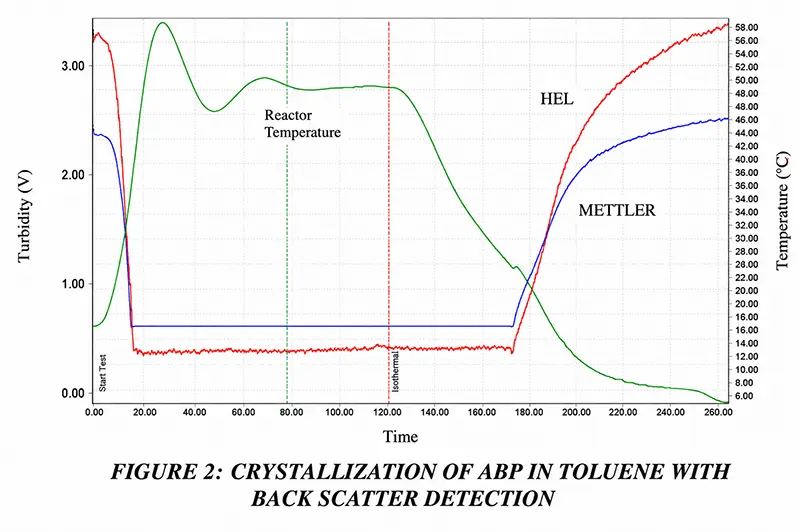
The HEL scattering probe and the Mettler probe are compared in Figure 2, where 4-acetyl biphenyl (ABP) in toluene is recrystallized.
The crystallization point is evident from the temperature kink, and this corresponds closely to the response of both probes. Thus, the probes are equally sensitive.
Transmission vs Back-Scattering
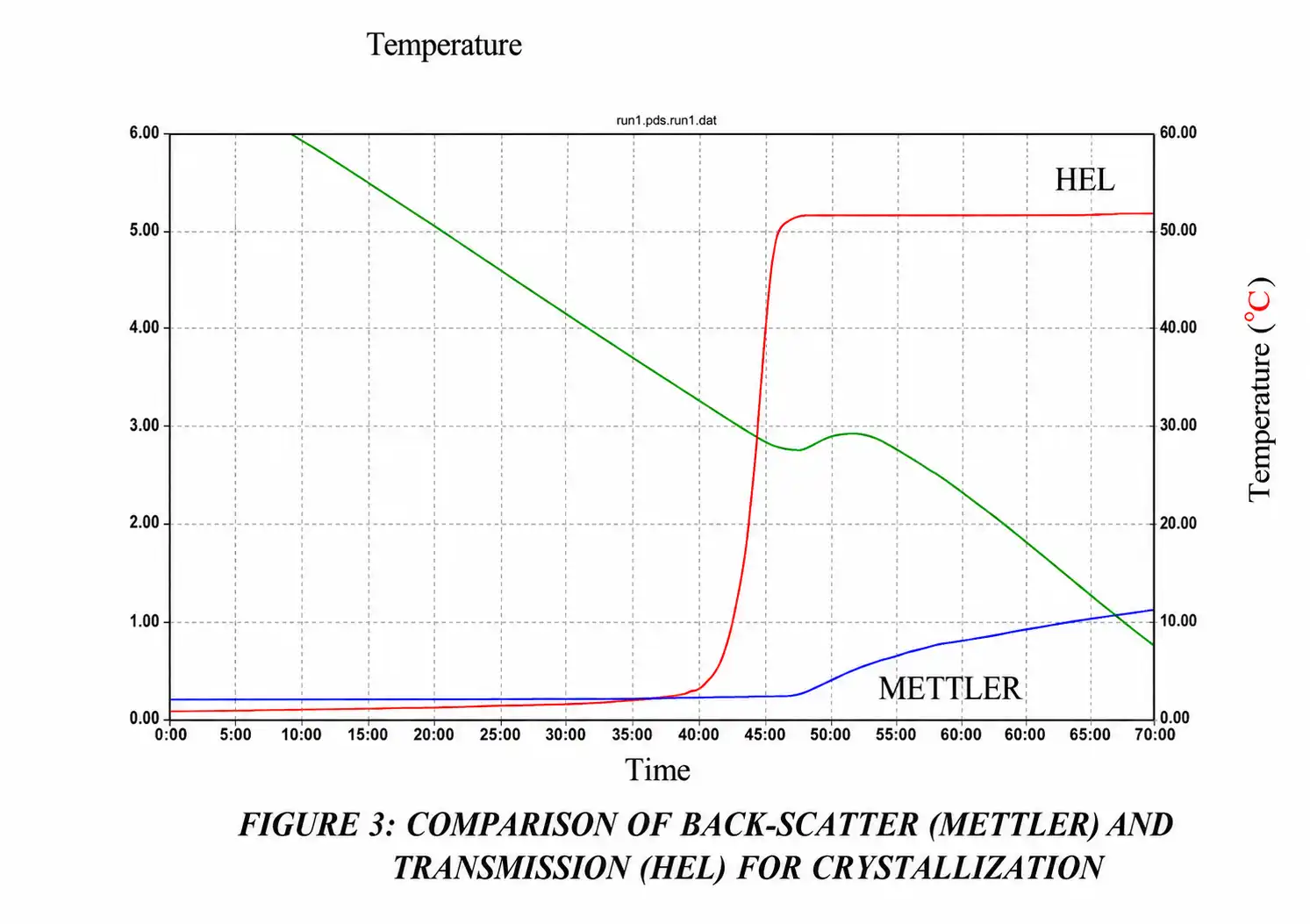
In Figure 3, the HEL back-scattering probe was replaced by the transmission type with a reflectance window, and compared against the Mettler probe.
The HEL probe picks up the event considerably sooner — a difference of around 4 minutes, equivalent to roughly 1 °C in temperature.
AstraZeneca have reported data on a different Mettler turbidity meter (FSC 402). Even with the gain set to an optimum level, the operator detected the appearance of crystals 12 minutes before the meter did (Ref. 1). That differs from our experience with the HEL detector, where the probe is often marginally faster than the operator.
Conclusions
The two turbidity techniques supported by HEL address the two main applications well. Back-scattering gives a linear response to suspended solids across a wider concentration range, while transmission detects the onset of crystallization earlier.
Miniature probes are also available, allowing turbidity studies at the ~2 mL scale, and a compact multi-probe turbidity unit is available for screening work.
Turbidity measurement of this kind underpins our crystallization and particle studies systems, including CrystalEYES and CrystalSCAN.
Reference 1: Parsons et al., Trans. IChemE, Vol 81, Part A, July 2003, pp. 700–704.
Data in this note is extracted from HEL internal report RO13.001.2004-02-12.
Frequently Asked Questions
Why compare HEL and Mettler turbidity systems?
Different turbidity measurement methods can produce different results depending on the application. This comparison examines how each system performs when measuring suspended solids and monitoring crystallization.
What is the difference between backscatter and transmission turbidity?
Backscatter measures light reflected by suspended particles, while transmission measures the reduction in light passing through the sample. The choice of method can affect sensitivity during crystallization studies.
Which turbidity method is better for crystallization monitoring?
The answer depends on the application. In this comparison, the transmission method detected the onset of crystallization earlier than the backscatter system, helping identify crystal formation sooner.
Why is early crystal detection important?
Detecting the first crystals as early as possible helps researchers measure the metastable zone width more accurately and optimize crystallization processes.
Can turbidity sensors measure suspended solids?
Yes. Turbidity sensors are commonly used to monitor changes in suspended solids concentration during chemical process development and crystallization experiments.
What is metastable zone width?
The metastable zone width is the temperature range between complete dissolution and the point where crystals begin to form. It is an important measure in crystallization process development.
Are backscatter turbidity sensors always the best choice?
Not necessarily. Backscatter works well for many applications, but transmission measurement may provide earlier detection of crystal formation in some crystallization processes.
Can turbidity measurement be used for process development?
Yes. Turbidity measurement is widely used during process development to monitor suspended particles, crystallization, dissolution, and changes within chemical processes.
Why does particle detection matter in crystallization?
Accurate particle detection allows researchers to identify nucleation earlier, improve process understanding, and develop more repeatable crystallization methods.
What should you consider when choosing a turbidity system?
Factors include the measurement principle, particle concentration, application, reactor size, required sensitivity, and whether suspended solids or crystallization monitoring is the main objective.