The Scale-up Challenge in Small Reactors
After initial screening, the ideal chemical and bio research involves development in multiple reactors in parallel, operating independently without compromise on controls. Ideally, a 10 to 100-fold scale-up of the results should be possible, and the key to this is how well the reactors are stirred, which impacts the overall reaction kinetics.
The challenge of agitation lies in the fact that research reactors are inevitably small yet still require all necessary probes to be in place, leaving little room for conventional overhead stirring. Stirring with magnetic fleas sitting in the bottom of the reactor is conventionally the only choice but it is a poor substitute for the real thing. More innovative substitutes are possible and will be described here.
Scalable small-scale heterogeneous hydrogenation
The ideal research reactor must provide an acceptably small working volume with adequate headspace for necessary probes and agitation, ideally ensuring ~100-fold scale-up of data. An example is a 16ml pressure reactor (rated up to 100 bar) with a diameter of 1-2 cm and a minimum working volume of 5ml, which has been used for parallel heterogeneous hydrogenation on the H.E.L PolyBLOCK platform.
This configuration was shown to produce results comparable to a 1 liter pressure vessel fitted with overhead stirring with 500ml of liquid, as shown in the comparison below (ref https://www.linkedin.com/feed/update/urn:li:activity:7475182152448417792)
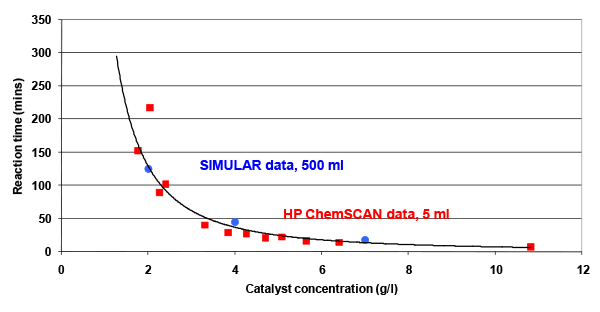
Hydrogenation of nitrobenzene using a Pd/C catalyst in 5 mL and 500 mL liquid volumes
The agitation design for the 5ml reactor used for the hydrogenation data above consists of a magnet encased in a U-shaped stirrer suspended on a shaft fixed to the lid, as shown below.
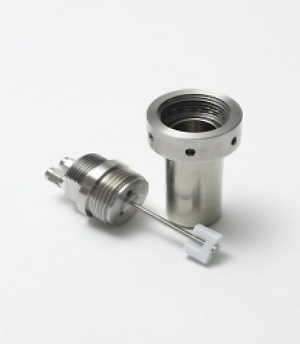
The PolyBLOCK provides a strong smagnet under the reactor capable of speeds of up to 1500 rpm, even in multiphase (liquid, gas, and powder) mixtures.This agitation design can be provided on glass and metal reactors.
Complex Reactor: Meeting Scale-up Criteria for Industrial Scale
More complex reactions – for example, fermentations – require lids with significantly more features, though the reactors must still be small enough to fit in the PolyBLOCK, as in the above example.
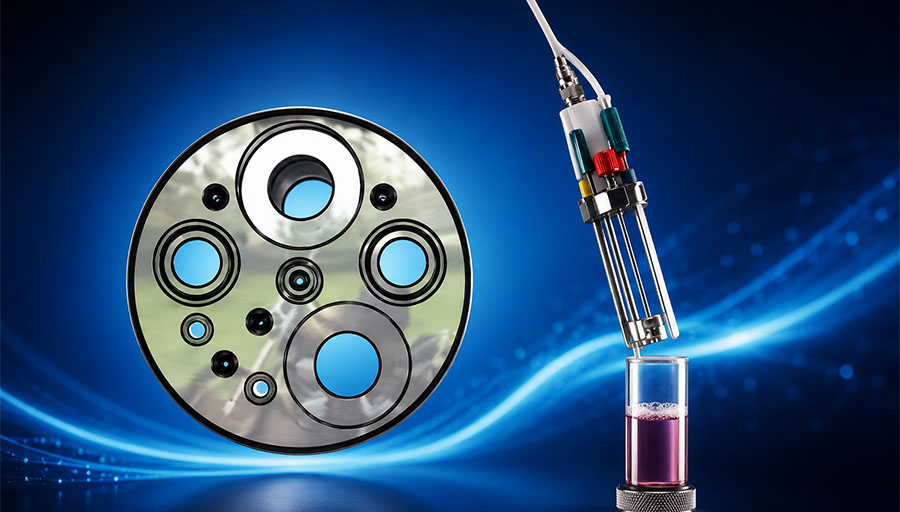
An example of such a lid, with multiple ports, is shown below, and a 100ml bioreactor fully equipped with the necessary probes, dosing, and reflux features.
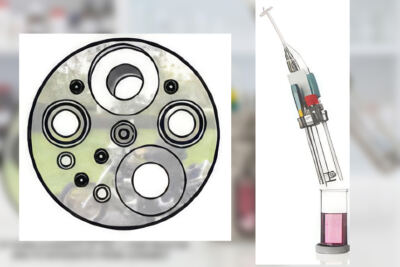
The above lid and probes are essential for monitoring a wide range of fermentation applications, plus the added bonus of being able to use 8 of them in parallel on the Polyblock.
The key to scalable data is in the agitation arrangement, shown below.
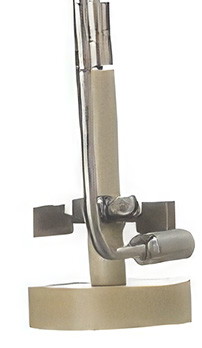
This consists of a flat disc (with a magnet inside) coupled to the shaft, with a standard Rushton stirrer fixed about 1 cm above the plate. Clearly, other types and multiple stirrers are possible.
The flat disc with a magnet inside it is close to the base of the reactor and thus couples to the magnet in the PolyBLOCK. This rotates the shaft/stirrer at speeds of up to 1500 rpm, similar to an overhead motor. Another important feature of the rotating disc and the Rushton stirrer is a gas sparger, which releases bubbles into the stirrer path, where they are dispersed throughout the reactor.
The miniature stirring arrangement, coupled with the lid design that enables multiple probes and fittings, successfully miniaturizes bio reactors 10 to 100-fold larger.
Miniature overhead stirring
The magnetic agitation designs above have two main limitations: first, they are ideally suited to stirring lower-viscosity liquids, and second, they pose problems with Raney nickel (and similar) catalysts, which will cling to magnetic stirrers.
This leaves no option but to use overhead mechanical stirring, and the challenge here is miniaturizing the magnetic coupling attached to the stirrer shaft and a suitable stirrer motor to drive it. Acceptable designs for this combination have been developed by H.E.L., and examples of practical applications will be presented in a subsequent post.
Reactor Scale-up: Frequently Asked Questions
What scale-up factor can small reactor agitation achieve?
With good agitation, a small-scale research reactor can deliver 10 to 100-fold scale-up. The scale-up criteria depend on mixing quality, since it drives the reaction kinetics that must hold from bench to industrial scale.
Why is agitation so critical when scaling up reactor data?
Reaction kinetics are governed by mass transfer and mixing, so the agitation regime must stay constant during scale-up for a successful scale-up. Stirrer velocity matters as much as the chemistry.
How does a 5 mL reactor produce data comparable to a 1 liter vessel?
Matching agitation velocity and mass transfer per unit volume allows the 5 mL reactor to behave like a 1 liter vessel, despite the difference in target scale. The heterogeneous hydrogenation results matched across both.
Can magnetic-coupled stirring really match an overhead motor?
Yes — the PolyBLOCK under-reactor magnet drives the shaft up to 1500 rpm, comparable to an overhead motor, even in multiphase mixtures. A Rushton stirrer and a gas sparger improve gas dispersion and heat transfer.
Why does small-scale hydrogenation matter for pharmaceutical development?
It lets teams screen conditions fast while generating data that holds at an industrial scale, speeding up process development and pharmaceutical manufacturing.
What are the limitations of miniature magnetic agitation?
Two: it suits moderate- to low-viscosity systems, and catalyst particles can stick to the magnetic stirrers, affecting performance in some advanced reactors.
Are there solutions available to overcome the limitations mentioned above?
Miniature magnetic drives and small electric motor combinations are being developed, and data from their use on small reactors will be available in the next few months.
How many small, independent reactors of the type mentioned in the article can a PolyBLOCK house?
There are two polyblock platforms, PolyBLOCK 4 and PolyBLOCK 8. Eight smaller reactors discussed in the article can be used in PolyBLOCK 8, as well as even smaller ones with available adapters.
Is there a way to use multiple larger-sized reactors on PolyBLOCK?
Reactors up to 500ml total volume can be used in the PolyBLOCK 4. Smaller reactors (including those mentioned in the article and even smaller ones) can also be used in the PB4 with suitable available adapters.
What are the other features of PolyBLOCK relevant to process development?
The Polyblock platforms can be used at process temperatures up to 250 °C and down to well below -50 °C by connecting to standard chillers. The reactors in a PolyBLOCK can be at totally different temperatures (up to 100 °C+ difference between them). The PolyBLOCK is simply a starting platform on which fully software-controlled, fully customized applications can be built.