Syngas has been around for more than a century. It’s a mixture built mostly from carbon monoxide and hydrogen, usually with some CO₂ and other gases mixed in, and it’s long served as a feedstock for fuels, hydrogen, methanol, and other bulk chemicals.
Lately, though, it’s getting attention for a different reason: what if biology, not just chemistry, could turn those waste gases into something valuable?
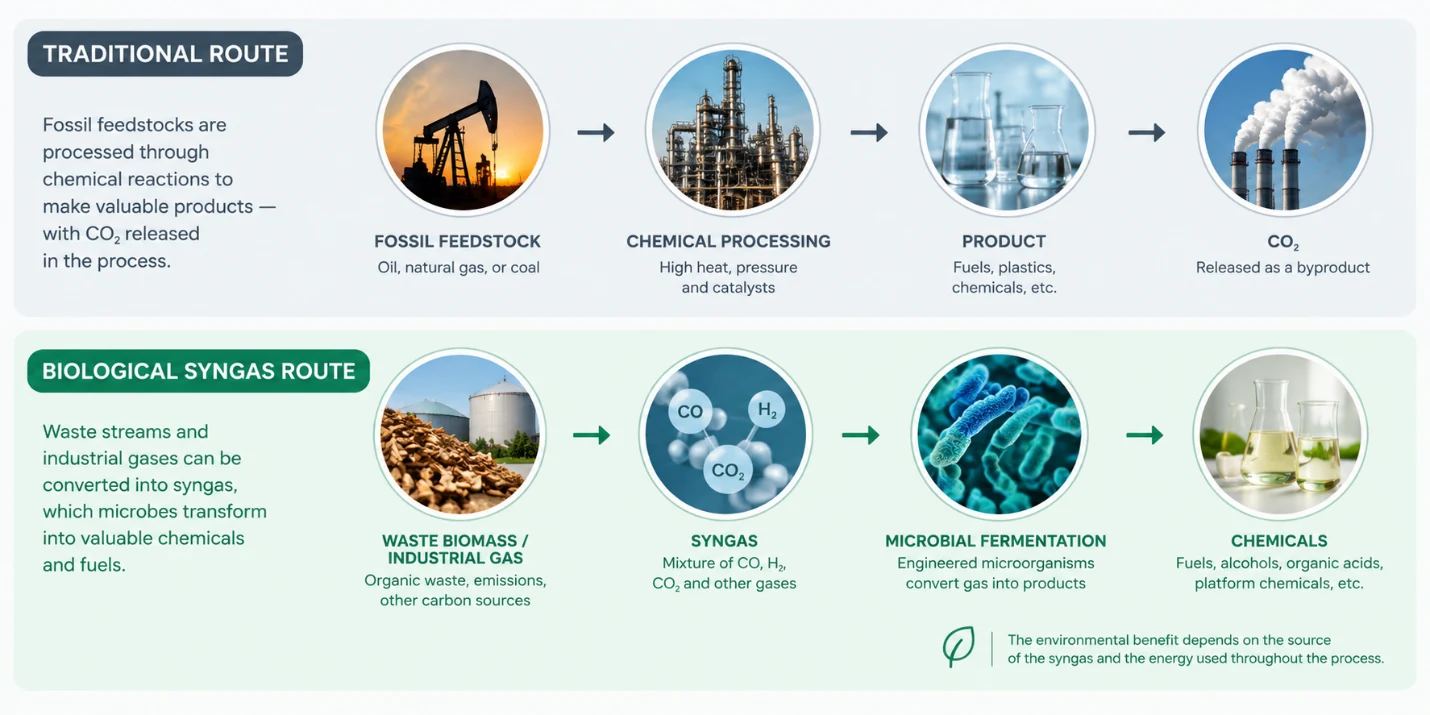
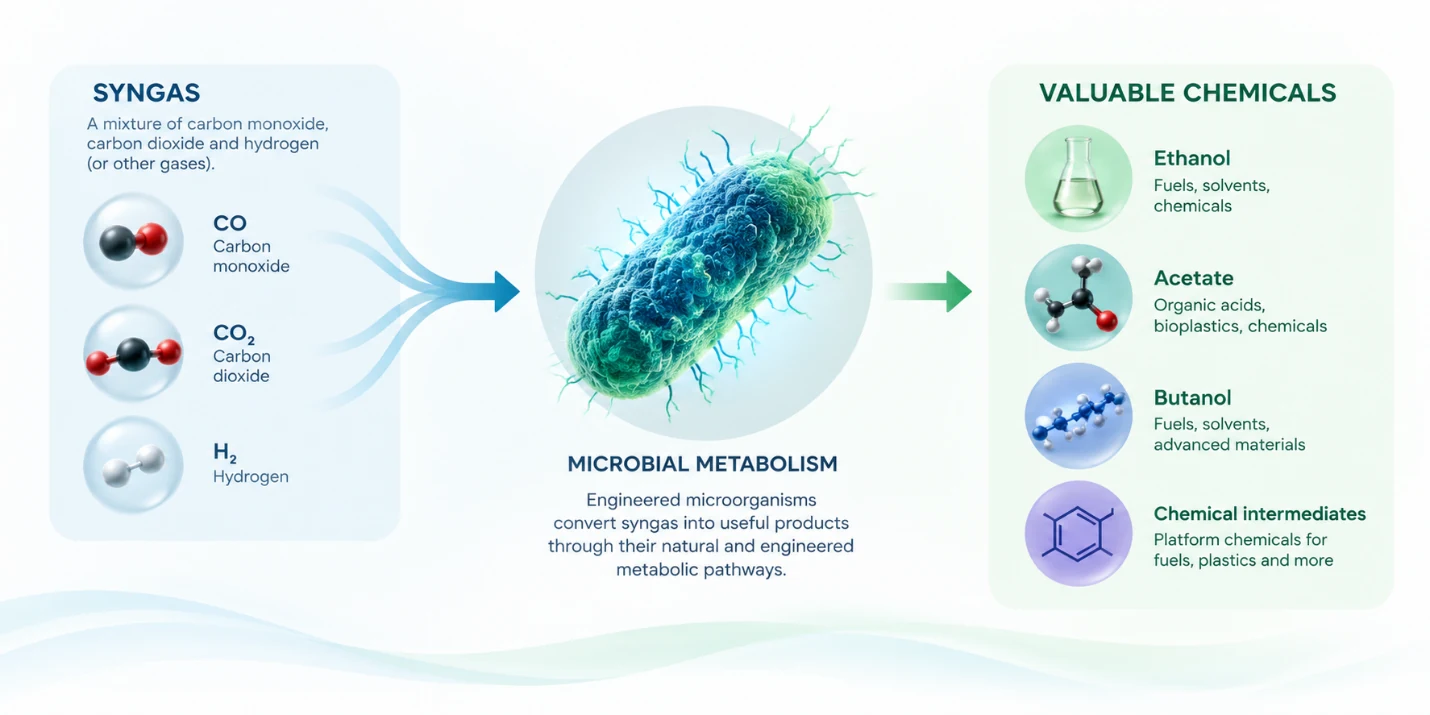
As industries look for ways to cut their reliance on fossil carbon, syngas fermentation has emerged as a genuinely interesting alternative to conventional catalytic conversion. Instead of leaning on high heat, high pressure, and metal catalysts, engineered microorganisms can consume carbon-containing gases directly and convert them into ethanol, acetate, butanol, and other platform chemicals3.
The core idea is almost deceptively simple: give a microbe the right gases and let its metabolism handle the chemistry. The challenge, as is often the case in biotechnology, is making that process efficient and robust enough to matter at industrial scale.
Syngas isn’t one thing
Before getting into “sustainable syngas,” it’s worth being clear about where the gas actually comes from, because that’s what determines whether any of this is sustainable at all.
Syngas can be produced by gasifying coal, natural gas, biomass, municipal waste, or other carbon-rich material. Carbon containing gas mixtures can also be sourced from industrial process streams. So “syngas” by itself doesn’t tell you much about its climate footprint, but the potential comes from where the carbon originates.
Rather than pulling new fossil carbon out of the ground to make chemicals, researchers are asking whether carbon that’s already circulating in things like industrial emissions or waste-derived gases, can serve as the feedstock instead. That’s part of a larger push toward a circular carbon economy: instead of fossil carbon → chemical → waste → emissions, the goal becomes waste carbon → syngas → microbial conversion → useful product.
For industries where cutting out carbon-based feedstocks entirely just isn’t realistic, that shift could matter quite a bit.
Microbes doing chemistry in unexpected ways
One of the more interesting groups here is acetogenic bacteria, which are organisms that have evolved to live on remarkably simple gases, using metabolic pathways that turn CO, CO₂, and H₂ into acetyl-CoA and other useful intermediates5.
Researchers can work with these pathways as they are, or engineer them to push the organism toward products it wouldn’t normally make on its own. That’s where synthetic biology earns its keep: rather than designing a manufacturing process from a blank page, scientists can take an existing biological system and redirect its metabolism toward the desired products – alcohols, organic acids, fuels, chemical intermediates.
This general approach is known as gas fermentation. It looks like ordinary fermentation in a lot of ways, except the feedstock isn’t a sugar solution; the carbon is coming in as a gas. That single difference changes many of the process development challenges.
Gas is a genuinely difficult feedstock
Anyone who’s spent time doing fermentation knows how much depends on the organism’s interaction with its environment. With syngas, that interaction gets a lot harder, simply because the feedstock is gaseous.
CO and H₂ have relatively low solubility in water. Getting enough gas out of the headspace or sparged bubbles, into the liquid, and finally to the cells is a real engineering challenge. Simply increasing the gas flow is not enough: mass transfer, bubble size, agitation, pressure, reactor geometry, microbial physiology, and gas composition all interact to determine how much of that gas the microbes can actually use4.
The organisms themselves shift the picture too, as fermentation runs on. A process tuned for one CO:CO₂:H₂ ratio can behave quite differently once that ratio drifts, which matters a great deal when the gas is coming from a real industrial or waste stream rather than a cylinder of laboratory-grade gas.
Scale-up problems start early
Gas fermentation is a good illustration of why scale-up can’t be left until the end of a project. A culture that performs well in a small reactor won’t necessarily behave the same way in a bigger one.
As reactor volume grows, mixing and gas transfer both change. Cells may see different dissolved gas concentrations. Temperature and pH gradients become more pronounced. And the relationship between gas flow and productivity can shift in ways that are hard to predict from bench-scale data alone.
This makes a strong case for understanding the process before scaling it, and it’s where small-scale parallel bioprocessing earns its place. Rather than changing one variable at a time, researchers can run multiple combinations of gas composition, agitation, temperature, pH, and nutrient availability side by side. The goal isn’t just finding the condition with the highest output; it’s understanding why that condition works, and whether it’ll hold up once the process gets bigger.
Why this could matter for hard-to-decarbonize industries
The appeal here goes beyond biotech for its own sake. Steelmaking, refining, waste management, and chemical manufacturing all produce large volumes of carbon-containing gas, and a fair amount of that is genuinely difficult to eliminate outright. Capturing and storing it is one option2. Using it as a feedstock is another.
LanzaTech has already demonstrated what this can look like in practice, converting carbon-rich industrial gases into ethanol at real scale, which is a working example of biological conversion plugged directly into industrial emissions1. That doesn’t make the emissions source carbon neutral by itself; the real environmental impact still depends on where the gas comes from, how much energy the process consumes, how long the resulting product lasts, and what would have happened to that carbon otherwise. But it does open up a different way of thinking about it: carbon that would’ve been treated as waste can instead become a raw material.
From fuels toward chemicals
Most of the early attention on gas fermentation has gone to fuels, ethanol especially. The bigger opportunity, though, may be broader than that.
Once a microbe can efficiently consume syngas, the same basic platform can often be redirected toward other products, such as chemical intermediates used in plastics, solvents, coatings, and various industrial materials3. That’s really where this gets interesting from a sustainability standpoint. The point isn’t necessarily to replace every fossil-derived chemical with a biological one; it’s to give molecules that currently depend on fossil carbon an additional route to market. One that, unlike conventional petrochemistry, can often run under fairly mild temperatures and pressures.
What’s needed next is better process data
The biology behind syngas fermentation is genuinely interesting, but how far the technology goes will depend just as much on process engineering. Researchers still need to work out which strains perform best under which gas compositions, how operating conditions affect productivity, and how to hold performance steady over long runs.
Answering those questions takes data, and usually a lot of experiments to get it. Parallel bioprocess development gives researchers a way to explore those variables at a scale that’s manageable in the lab while still capturing the process behavior that actually matters. For a technology like this, that can shorten the distance between an interesting microbial pathway and something that might eventually run at industrial scale.
A different way to think about industrial carbon
The most interesting part of syngas fermentation might not be the technology at all, but the shift in mindset underneath it. Industrial carbon has mostly followed one path: extract it, transform it, release it. Biological gas conversion offers a different one: use it again.
Feedstock variability, gas transfer limits, process economics, downstream processing costs, scale-up risk, and the availability of the right infrastructure all remain real challenges. But biotechnology is increasingly giving researchers a way to work with carbon sources that used to be dismissed as too dilute, too variable, or just too hard to use.
The future of sustainable chemicals may end up depending less on eliminating carbon altogether, and more on keeping it in circulation. Sometimes the most sustainable feedstock isn’t one we grow, it’s one we’ve already used once.
Where bioprocess development fits
Turning syngas into chemicals takes a lot more than finding a microbe that happens to eat gas. Researchers need to understand how gas composition, mass transfer, agitation, feeding, pH, temperature, and microbial physiology interact across the whole process.
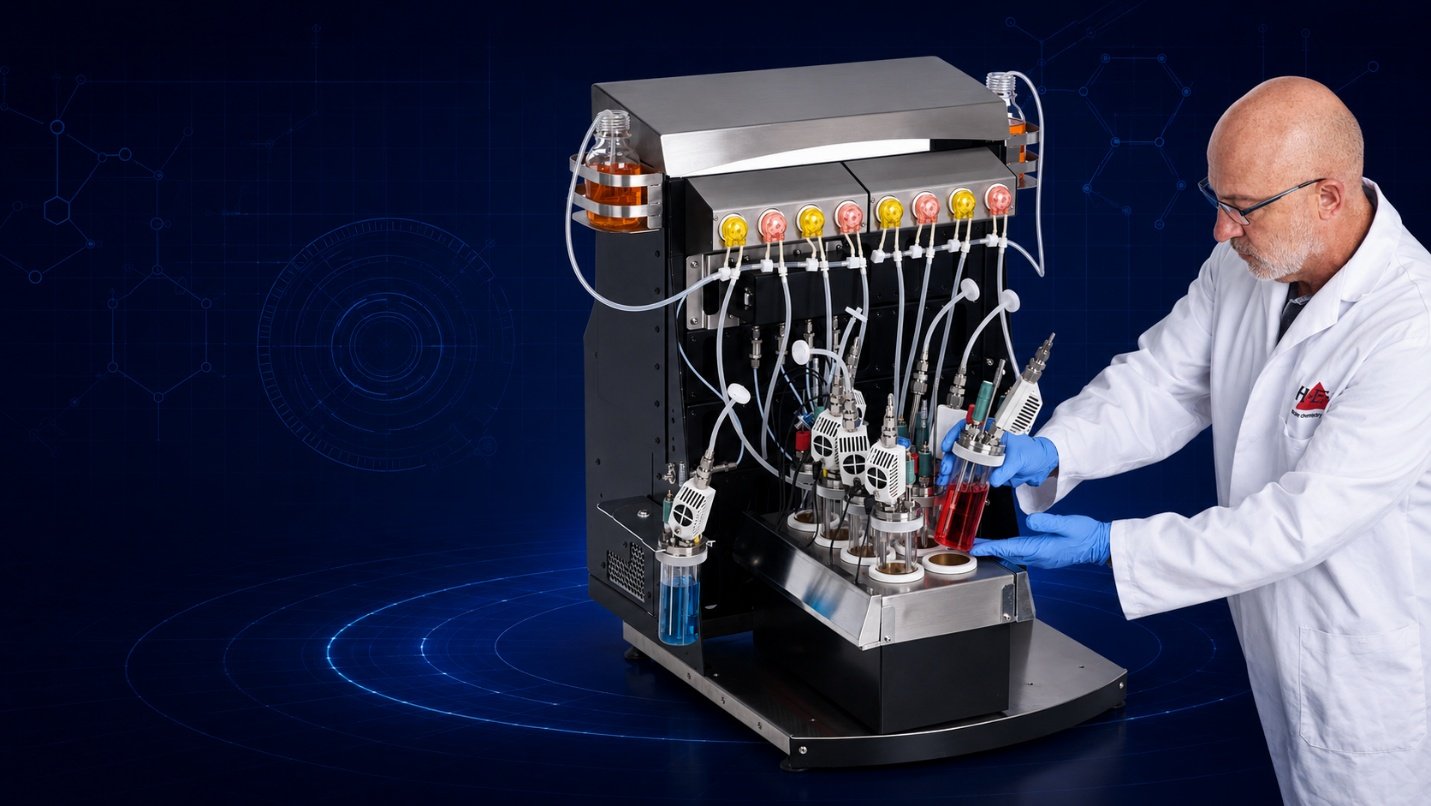
Early-stage parallel bioprocess development is well suited because it allows researchers to investigate these variables efficiently, compare different operating strategies, and build the data needed to move promising gas-fermentation systems toward larger-scale work. The BioXplorer range offers a flexible way to explore these bioprocess conditions before committing to larger reactors, and the pressure-rated BioXplorer 400P is designed specifically for gas-dependent fermentations where raising gas solubility matters.
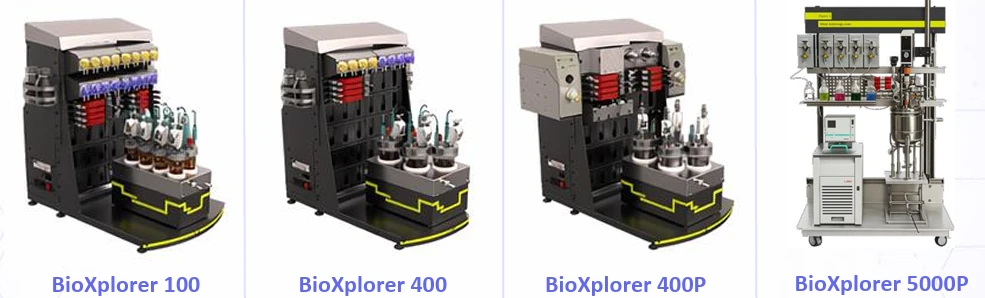
Curious how parallel bioprocess development supports gas fermentation work? Explore the BioXplorer range to see how researchers are characterising gas-fed strains and optimising conditions before scale-up.
Related reading
The rise of carbon-negative biomanufacturing: can microbes help fight climate change?
Top 5 challenges in maximizing biofuel and sustainable aviation fuel fermentation yields
Achieving consistent oxygen transfer: the impact of kₗa on fermentation scale-up
Frequently asked questions
What is syngas fermentation?
Syngas fermentation, also called gas fermentation, uses microorganisms — most often acetogenic bacteria — to convert a gas mixture of carbon monoxide, hydrogen and carbon dioxide directly into products such as ethanol, acetate, butanol and other platform chemicals. The feedstock enters the bioreactor as a gas rather than as a sugar solution, and the microbe’s metabolism does the chemistry that a conventional route would achieve with high heat, high pressure and metal catalysts.
Is syngas a sustainable feedstock?
Only sometimes. Syngas can be produced by gasifying coal, natural gas, biomass or municipal waste, or captured from industrial process streams such as steel mill off-gas. The climate benefit depends on where the carbon originates, how much energy the gasification and fermentation steps consume, how long the resulting product locks the carbon away and what would otherwise have happened to that carbon. Syngas from waste or industrial emissions can support a circular carbon economy; syngas from fresh fossil carbon does not.
Which microbes are used for syngas fermentation?
Acetogenic bacteria are the main group. Species of Clostridium such as C. autoethanogenum and C. ljungdahlii use the Wood–Ljungdahl pathway to turn CO, CO₂ and H₂ into acetyl-CoA, which the cell then converts into acetate, ethanol and other products. Synthetic biology lets researchers redirect that metabolism toward compounds the organism would not normally make, including butanol, isopropanol, acetone and various chemical intermediates.
Why is gas transfer the main bottleneck in syngas fermentation?
Carbon monoxide and hydrogen are poorly soluble in water, so the rate at which gas moves from bubbles into the liquid and reaches the cells usually limits productivity before the microbes’ metabolism does. Mass transfer depends on agitation, bubble size, sparging strategy, pressure and reactor geometry, and these interact with the gas composition and the physiology of the culture. Simply increasing the gas flow rate does not solve the problem; raising pressure to increase solubility is one of the more effective levers.
What products can be made from syngas fermentation?
Ethanol has received most of the early attention and is produced commercially from industrial off-gas by LanzaTech. The same microbial platform can be redirected toward acetate, butanol, 2,3-butanediol, isopropanol and other intermediates used in plastics, solvents, coatings and materials. Fermentation-derived products can also be upgraded chemically, so the route extends into sustainable aviation fuel and other higher-value molecules.
How do parallel bioreactors help develop a gas fermentation process?
Gas fermentation has many interacting variables — gas composition and ratio, agitation, pressure, temperature, pH and nutrient feeding — and testing them one run at a time is slow. Parallel systems let researchers compare several combinations side by side under identical monitoring and control, so differences can be attributed to the variable rather than to run-to-run drift. The BioXplorer 400P runs four reactors at up to 10 bar with independently controlled gas blends for each vessel, and the BioXplorer 5000 takes a single vessel to 1–5 L, also under pressure, for scale-up studies.
1. LanzaTech — information on gas fermentation and carbon recycling technologies. lanzatech.com/
2. International Energy Agency — Carbon capture, utilisation and storage: background on carbon utilisation and industrial emissions. iea.org/energy-system/renewables-and-low-emissions/carbon-capture-utilisation-and-storage
3. Köpke, M. & Simpson, S.D. (2020) “Pollution to products: recycling of ‘above ground’ carbon by gas fermentation.” Current Opinion in Biotechnology, 65, 180–189. doi.org/10.1016/j.copbio.2020.02.017
4. García-Casado, S., Muñoz, R. & Lebrero, R. (2025) “Towards syngas biorefineries: the potential of microbial consortia for syngas valorisation.” Biotechnology Advances, 85, 108699. doi.org/10.1016/j.biotechadv.2025.108699
5. Dürre, P. & Eikmanns, B.J. (2015) “C1-carbon sources for chemical and fuel production by microbial gas fermentation.” Current Opinion in Biotechnology, 35, 63–72. doi.org/10.1016/j.copbio.2015.03.008