
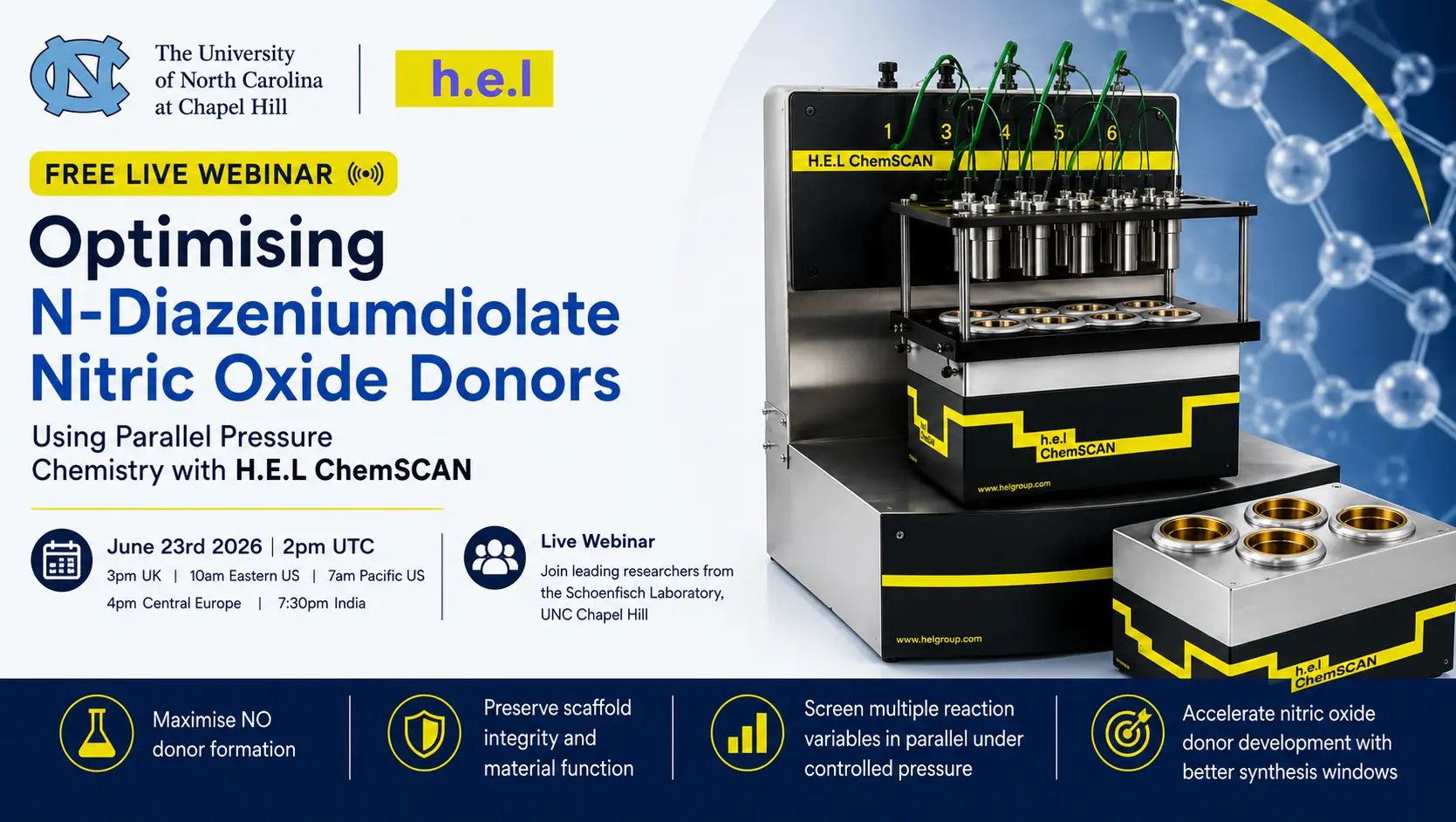
Free Live Webinar
Optimising N-Diazeniumdiolate Nitric Oxide Donors Using Parallel Pressure Chemistry
June 23rd 2026 | 2pm UTC
(3 pm UK, 10 am Eastern US, 7 am Pacific US, 4 pm Central Europe, 7:30 pm India)
Nitric oxide-releasing materials have strong potential across biomedical, antimicrobial and drug delivery research. But developing these materials is not just a case of maximizing nitric oxide donor formation.
The real challenge is more balanced.
Researchers need to increase N-diazeniumdiolate nitric oxide donor loading while preserving the integrity, function and bioactivity of sensitive polymeric biomaterial scaffolds.
This live webinar, hosted by H.E.L in collaboration with the University of North Carolina at Chapel Hill, will explore how parallel pressure chemistry can support this type of reaction optimisation.
The session will focus on how researchers used H.E.L ChemSCAN to screen reaction variables under controlled pressure conditions. It will also discuss why the highest nitric oxide donor loading does not always lead to the best final material.
About the Webinar
N-diazeniumdiolate nitric oxide donors are widely studied for their ability to release nitric oxide under controlled conditions. This makes them valuable in areas such as antimicrobial materials, wound healing, medical devices and other biomedical applications.
However, the chemistry can be difficult to control.
Increasing nitric oxide donor formation may improve release potential, but it can also place stress on the polymeric scaffold. If the reaction conditions are too harsh, the scaffold may lose mechanical strength, structure, function or biological value.
This creates a practical research problem.
How do you improve nitric oxide donor loading without compromising the material that needs to carry and deliver it?
This webinar will examine that question through the lens of parallel pressure chemistry. Attendees will gain insight into how pressure, reaction time, temperature, solvent systems and base concentration can influence N-diazeniumdiolate formation.
The session will also show how controlled pressure screening can help researchers compare reaction conditions more efficiently and make better decisions during material development.
Why This Topic Matters
In nitric oxide-releasing biomaterials, more is not always better.
A material with high NO donor loading may appear successful at first. But if the scaffold has been damaged during synthesis, the final material may not perform as required.
For researchers, this means reaction optimisation must consider both chemical output and material preservation.
This is where parallel pressure chemistry can offer value. By allowing multiple reaction conditions to be screened under controlled pressure, researchers can compare outcomes more clearly. This helps identify conditions that support NO donor formation while reducing unwanted scaffold degradation.
The webinar will provide a practical view of this approach and how it was applied using H.E.L ChemSCAN.
What You Will Learn
Attendees will gain a practical view of how parallel pressure chemistry can support nitric oxide donor development.
The webinar will cover:
- How nitric oxide pressure affects N-diazeniumdiolate formation
- Why scaffold preservation matters in NO-releasing biomaterials
- How reaction time can affect donor loading and material stability
- How temperature can influence reaction outcomes
- How solvent systems and base concentration can change final material performance
- How parallel pressure chemistry helps compare reaction conditions more efficiently
- How H.E.L ChemSCAN supports controlled pressure reaction screening
- Why the highest NO donor loading may not always produce the best final material
Key Themes
Balancing Donor Loading and Scaffold Integrity
The session will explore why optimisation must go beyond maximising NO donor formation. Preserving the scaffold is essential if the final material is expected to retain its intended function.
Controlled Pressure Screening
Attendees will learn how controlled pressure conditions can help researchers study nitric oxide donor formation in a more structured and efficient way.
Parallel Reaction Comparison
The webinar will show how parallel screening can reduce trial-and-error work by allowing different variables to be compared under controlled conditions.
Practical Research Insight
The session will focus on real research use, not just theory. It will show how ChemSCAN was used to support reaction screening and material development decisions.
Webinar Date and Time
June 23rd 2026 | 2pm UTC
3pm UK
10am Eastern US
7am Pacific US
4pm Central Europe
7:30pm India
Reserve Your Free Place
Join H.E.L and the University of North Carolina at Chapel Hill for this free live webinar.
Reserve your free place today to learn how parallel pressure chemistry can support the optimisation of N-diazeniumdiolate nitric oxide donors while helping preserve sensitive biomaterial scaffolds.
Featured Speakers
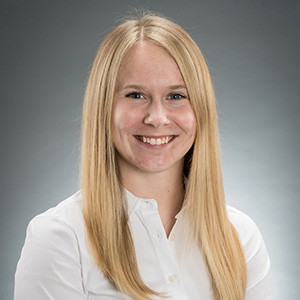
Maggie Purvis
Schoenfisch Laboratory
University of North Carolina at Chapel Hill
Maggie’s doctoral work focused on the development of nitric oxide-releasing materials for biomedical applications. A significant part of her research used H.E.L ChemSCAN to optimize reaction conditions for N-diazeniumdiolate formation while reducing degradation of polymeric backbones.
Who Should Attend
This webinar is designed for scientists, researchers and technical teams working in:
- Biomaterials
- Polymer chemistry
- Nitric oxide-releasing materials
- Drug delivery
- Antimicrobial technologies
- Biomedical material development
- Pressure chemistry
- Reaction optimisation
- Controlled reaction screening
- Medical device material research
It will be particularly relevant for teams working with sensitive polymeric scaffolds, reactive gas chemistry, NO donor systems or pressure-based synthesis methods.