FlowCAT | A Bench-Top, High Pressure Flow Catalysis Platform
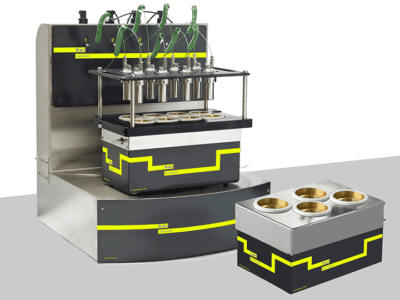
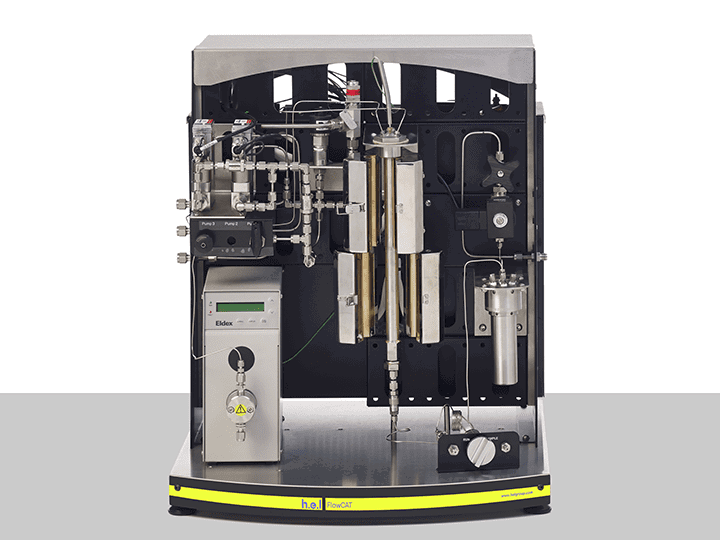
FlowCAT is an automated continuous flow high pressure reactor system designed for process development, catalyst evaluation, and reaction optimization. It enables precise control of temperature, pressure, and gas and liquid feed rates for reproducible operation under demanding conditions. Its flexible and compact design supports continuous flow chemistry development and scale up.
Overview
Continuous Flow Reactor Platform
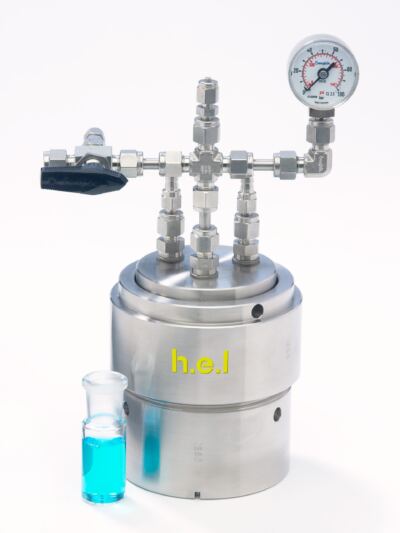
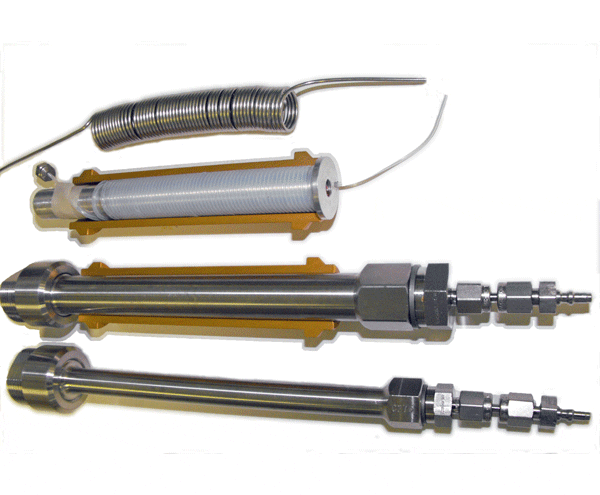
FlowCAT is a high performance continuous flow reactor system designed for developing and optimizing chemical processes under high pressure conditions. Typically configured with fixed bed tubular reactors, it supports both homogeneous and heterogeneous reactions, making it suitable for a wide range of applications.
Precise Process Control
The system provides real time control of temperature, pressure, and gas and liquid feed rates, ensuring accurate and reproducible operation. This level of control is essential for understanding reaction kinetics and optimizing process conditions in continuous flow chemistry.
Flexible Applications
FlowCAT is widely used in applications such as hydrogenation, oxidation, carbonylation, and Fischer Tropsch synthesis. It is also well suited to industries including biofuel research and petrochemical processing, where continuous flow systems are critical for efficient production.
High Throughput Process Development
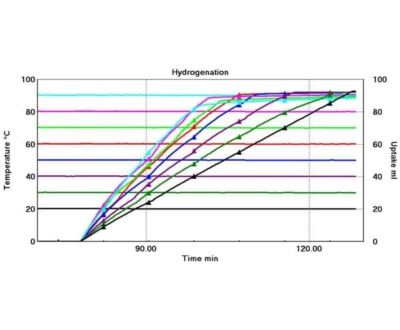
The platform allows multiple process conditions to be explored sequentially within a single automated run. Parameters can be pre programmed or adjusted in real time, enabling rapid screening, yield optimization, and catalyst evaluation without the need for constant operator input.
Compact and Automated Design
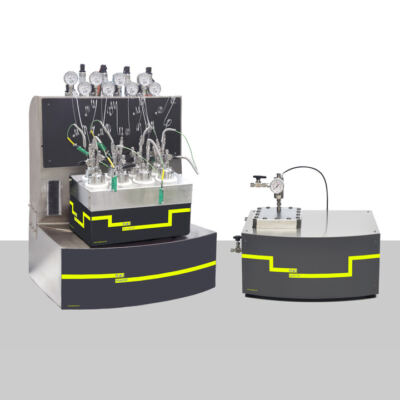
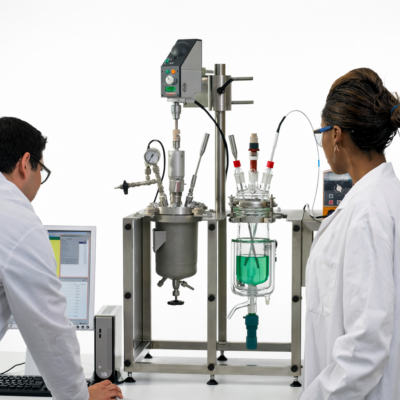
FlowCAT combines a compact footprint with high levels of automation, making it easy to integrate into laboratory environments. Its unattended operation capability improves efficiency while maintaining precise control over complex reaction systems.
Scale Up and Production Capability
The system supports seamless transition from laboratory development to small scale continuous production. This makes FlowCAT a valuable tool for bridging the gap between research and industrial application in continuous flow chemistry.
Technical Literature
The following is a list of supporting Technical Literature.
Investigating Zinc Oxide-Modified Mordenite as an Effective Catalyst for the Dehydrogenation of Ethanol utilizing the FlowCAT
Investigating a Sponge Metal Catalysts in a Trickle Bed Reactor for Continuous Hydrogenation Inflow
Publications
The following are a list of some technical publications which highlight the use of the equipment.
Hydrodeoxygenation of Guaiacol over Ni–Mo2C Catalysts: Effect of Synthesis Strategy on Activity and SelectivityC
Davit Davtyan, Artur Aghoyan, Gurgen Aleksanyan, Vahram Ghazaryan, Argam Akopyan
03-Apr-2026
https://pubs.acs.org/doi/10.1021/acs.energyfuels.6c00573?ref=pdf(Subscription or purchase maybe required for full access)
Evaluation and Screening of Spherical Pd/C for Use as a Catalyst in Pharmaceutical-Scale Continuous Hydrogenations
Eneritz Fernandez-Puertas, Andrew J. Robinson, Hannah Robinson, Shainthavaan Sathiyalingam, Heather Stubbs, and Lee J. Edwards
01-Jun-2020
https://doi.org/10.1021/acs.oprd.0c00183(Subscription or purchase maybe required for full access)
Continuous Flow Synthesis. A Pharma Perspective
Laia Malet-Sanz and Flavien Susanne
01-Jan-2020
https://doi.org/10.1021/jm2006029(Subscription or purchase maybe required for full access)
Evaluation of Sponge Metal Catalysts in a Trickle Bed Reactor for the Continuous Hydrogenation of an Aliphatic Nitro Intermediate
Antonella Carangio, Lee J. Edwards, Eneritz Fernandez-Puertas, Jerome F. Hayes, Maciej M. Kucharski, Graham W. Rutherford, Katherine M. P. Wheelhouse, and Glynn D. Williams
01-Jan-2020
https://doi.org/10.1021/acs.oprd.9b00447(Subscription or purchase maybe required for full access)
Flow fine synthesis with heterogeneous catalyst
Koichiro Masuda, Tomohiro Ichitsuka, Nagatoshi Koumura, Kazuhiko Sato, Shū Kobayashi
01-Apr-2018
https://doi.org/10.1016/j.tet.2018.02.006 (Subscription or purchase maybe required for full access)
High-yielding continuous-flow synthesis of antimalarial drug hydroxychloroquine
Eric Yu‡ORCID Logo, Hari P. R. Mangunuru‡ORCID Logo, Nakul S. TelangORCID Logo, Caleb J. Kong, Jenson Verghese, Stanley E. Gilliland IIIORCID Logo, Saeed Ahmad, Raymond N. Dominey and B. Frank Gupton
01-Mar-2018
https://doi.org/10.3762/bjoc.14.45(Subscription or purchase maybe required for full access)
Solvent-Free Continuous Operations Using Small Footprint Reactors: A Key Approach for Process Intensification
https://doi.org/10.1021/acssuschemeng.6b00287
01-Mar-2016
https://doi.org/10.1021/acssuschemeng.6b00287(Subscription or purchase maybe required for full access)
Process Intensification for the Continuous Flow Hydrogenation of Ethyl Nicotinate
Takashi Ouchi,†,‡ Claudio Battilocchio,† Joel M. Hawkins,§ and Steven V. Ley
01-Jul-2014
https://doi.org/10.1021/op500208j(Subscription or purchase maybe required for full access)
Adsorption of dimethyl ether (DME) on zeolite molecular sieves
Jai B.LadYassir T.Makkawi
01-Jul-2014
http://publications.aston.ac.uk/id/eprint/23396/1/Adsorption_of_dimethyl_ether_DME_on_zeolite_molecular_sieves.pdf (Subscription or purchase maybe required for full access)

The H.E.L FlowCAT is a very robust, compact and flexible apparatus for high pressure heterogeneous catalytic processes. Its small footprint and versatility, along with the advantage of having reliable safety features, make the H.E.L FlowCAT an excellent piece of equipment to use. It has impressive potential for scaling up procedures.



Teva Czech Industries - Teva Czech Industries

Industries and Applications
Hydrogen economy for industrial and energy applications
Development of catalytic processes for hydrogen production from fossil fuels

Industrial paints, alcohols / Oxo-Process -Aldehyde synthesis
Perform oxo Process, hydroformylation, and carbonylation of Aldehydes.
Syngas & CO-Based Catalysis
Investegate reactions involving CO, CO₂, syngas, and mixed gas feeds under regulated pressure for carbonylation,…

Related Articles