AutoMATE | Linear, Automated Parallel Synthesis Platform
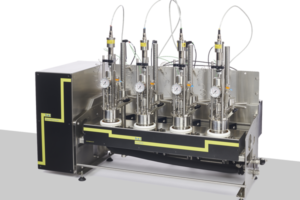
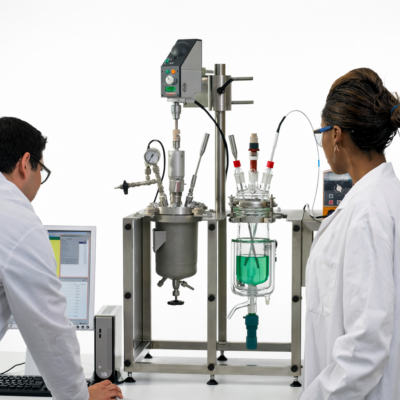
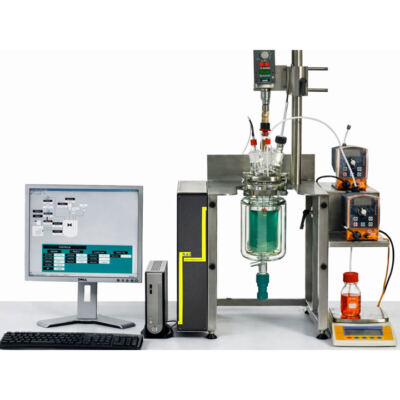
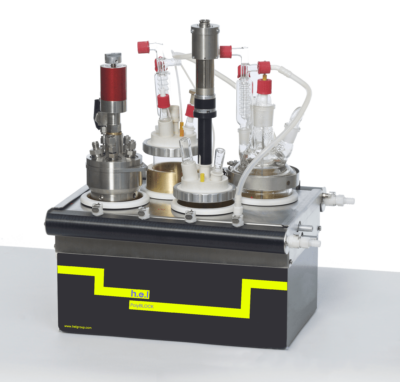
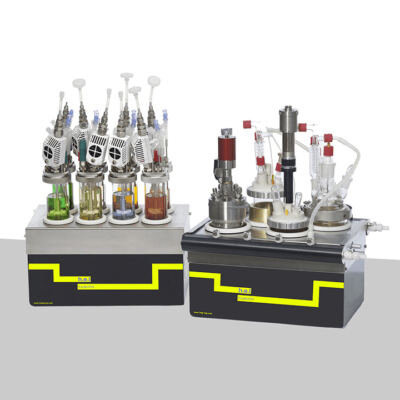
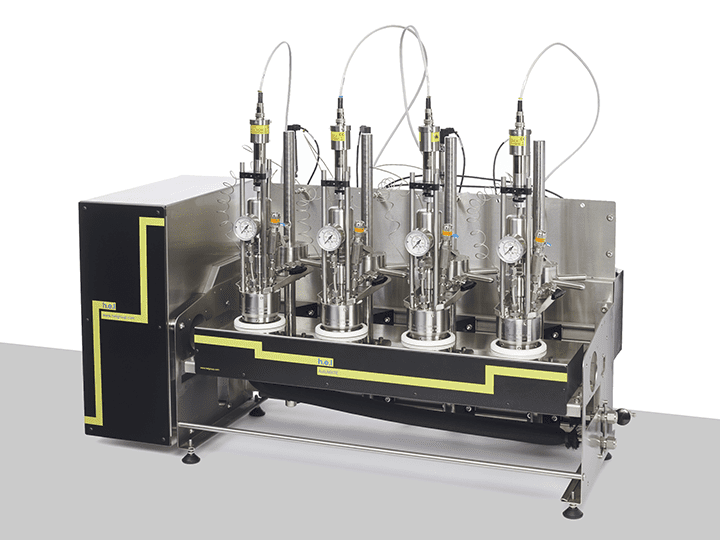
Auto-MATE is a linear automated parallel synthesis platform designed for chemical synthesis, process development, and design of experiment screening. It features independently controlled reactors with flexible configurations to support a wide range of applications, including catalyst screening and crystallization studies. With advanced automation and an extended temperature range, Auto-MATE enables precise, scalable, and efficient experimentation.
Ambient Pressure PolyBLOCK & AutoMATE Brochure
Overview
Automated Parallel Synthesis Platform
Auto-MATE is a flexible automated reactor system designed for parallel synthesis and process optimization. Its linear platform supports multiple independently controlled reactors, making it ideal for design of experiment studies and complex chemical processes. Compared to more compact systems, Auto-MATE is suited to demanding applications requiring greater flexibility, higher performance, and easier customization.
Flexible Reactor Configuration
The system supports a wide range of reactor types, including glass and metal vessels with volumes up to 500mL. It can be integrated with catalyst screening reactor blocks, enabling efficient evaluation of catalytic reactions. Compatibility with high pressure, vacuum, and continuous sampling systems ensures adaptability across different chemistries and processes.
Advanced Temperature and Stirring Control
Auto-MATE provides precise and independent temperature control for each reactor, with standard operation from ambient to 250°C and options extending from minus 40°C to 350°C. Each reactor is equipped with individual heating mantles, allowing significant temperature variation across experiments.
Independent stirring options include overhead agitation for highly viscous systems and optional magnetic stirring for simplified operation, ensuring reliable mixing across a wide range of applications.
Automation and Software Control
Controlled by advanced software, Auto-MATE enables automated workflows with multi step recipes, real time data logging, and feedback control. This ensures consistent, repeatable experiments while improving efficiency in process development and optimization.
Enhanced Functionality and Integration
Auto-MATE supports a wide range of additional modules, including liquid dosing and sampling, gas feed control, reflux and inerting options, and online calorimetry. Integration with analytical tools such as FTIR, Raman, and particle sizing probes enables deeper process insight and real time monitoring.
Safety and Reliability
Built with safety in mind, Auto-MATE includes configurable reaction detection and automatic shutdown procedures. Integrated hardware and software safeguards ensure safe operation, even under demanding experimental conditions.
Scalable and Customizable Design
The modular design of Auto-MATE allows for easy expansion and customization to meet evolving research needs. This makes it a powerful solution for laboratories seeking a scalable automated platform for chemical synthesis and process development.
Publications
The following are a list of some technical publications which highlight the use of the equipment.
Understanding the agglomerate crystallisation of hexamine through X-ray microscopy and crystallographic modelling
Thai T.H. Nguyen, Parmesh Gajjar, Jun Sun, Robert B. Hammond, Darragh Murnane, Benjamin Tordoff, Erik Lauridsen, Philip J. Withers and Kevin J. Roberts
01-Feb-2023
https://www.sciencedirect.com/science/article/pii/S0022024822004687(Subscription or purchase maybe required for full access)
Economical and scalable synthesis of 6-amino-2-cyanobenzothiazole
Jacob R. Hauser1,2, Hester A. Beard1,2, Mary E. Bayana1,3, Katherine E. Jolley1,3, Stuart L. Warriner1,2 and Robin S. Bon*2,4
01-Sep-2021
https://doi.org/10.3762/bjoc.12.189(Subscription or purchase maybe required for full access)
Concentration and Separation of Heavy Rare-Earth Metals at Stripping Stage
Olga Cheremisina, Vasiliy Sergeev , Alexander Fedorov * and Daria Alferova
01-Dec-2019
https://doi.org/10.3390/met9121317(Subscription or purchase maybe required for full access)
Continuous formation of N-chloro-N,N-dialkylamine solutions in well-mixed meso-scale flow reactors
A. John Blacker and Katherine E. Jolley
01-Dec-2015
https://doi.org/10.3762/bjoc.11.262(Subscription or purchase maybe required for full access)
Comprehensive kinetic model for the dissolution, reaction, and crystallization processes involved in the synthesis of aspirin
David E. Joiner, Julien Billeter, Mary Ellen P. McNally, Ron M. Hoffman and Paul J. Gemperline
01-Feb-2014
https://doi.org/10.1002/cem.2605(Subscription or purchase maybe required for full access)
Rheological and Hydrogenation Study using a Flow Modified Sponge Ni Catalyst
J. Matt Farmer1*, Norman Marin-Astorga1, Bruce Lacey1, Steve McMahon1, and Chandresh Malde2
01-Jul-2013
https://www.researchgate.net/profile/Matt_Farmer3/publication/293653558_Rheological_and_Hydrogenation_Study_using_a_Flow_Modified_Sponge_Ni_Catalyst/links/56ba4bc608ae6a0040adeb24/Rheological-and-Hydrogenation-Study-using-a-Flow-Modified-Sponge-Ni-Catalyst.pdf(Subscription or purchase maybe required for full access)
Mixed-level supersaturated design application to a robustness study on an organic synthesis
Alice Croguennoc, Marc Frédéric, Magalie Claeys-Bruno, Roger Phan-Tan-Luu, Michelle Sergent
01-Apr-2012
https://doi.org/10.1016/j.chemolab.2012.01.005(Subscription or purchase maybe required for full access)
A novel technique combining high-resolution synchrotron x-ray microtomography and x-ray diffraction for characterization of micro particulates
David R Merrifield1, Vasuki Ramachandran1, Kevin J Roberts1, Wesley Armour2, Danny Axford2, Mark Basham2, Thomas Connolley2, Gwyndaf Evans2, Katherine E McAuley2, Robin L Owen
01-Sep-2011
http://dx.doi.org/10.1088/0957-0233/22/11/115703(Subscription or purchase maybe required for full access)
Crystal Product Engineering in the Seeded Cooling Crystallization of Adipic Acid from Aqueous Solution
O. Narducci,† A. G. Jones,*,† and E. Kougoulos‡
01-Jul-2011
https://doi.org/10.1021/op200029h(Subscription or purchase maybe required for full access)
Oligomerisation of linear 1-olefins using a chlorogallate(III) ionic liquid
Martin P. Atkins 1 , Kenneth R. Seddon 2 , and Małgorzata Swadźba-Kwaśny 2
01-Jun-2011
https://doi.org/10.1351/PAC-CON-10-12-03(Subscription or purchase maybe required for full access)
The influence of reaction temperature on the oscillatory behaviour in the palladium-catalysed phenylacetylene oxidative carbonylation reaction
Katarina Novakovic,* Ankur Mukherjee, Mark Willis, Allen Wright and Steve Scott
01-Aug-2009
https://doi.org/10.1039/b905444h(Subscription or purchase maybe required for full access)
Investigation of pH Effect on Hydrogenation Reaction of Dextrose to Sorbitol using a Mo promoted Sponge Ni catalyst
J. Matt Farmer*, Steven L. McMahon, and Bruce M. Lacey
01-Jun-2009
http://nacatsoc.org/21nam/data/papers/Paper2250.pdf(Subscription or purchase maybe required for full access)
Deactivation and regeneration of ruthenium on silica in the liquid-phase hydrogenation of butan-2-one
Haresh G. Manyar Daniel Weber Helen Daly Jillian M. Thompson David W. Rooney Lynn F. Gladden E. Hugh Stitt J. Jose Delgado Serafin Bernal Christopher Hardacre
01-May-2009
https://doi.org/10.1016/j.jcat.2009.04.013(Subscription or purchase maybe required for full access)
Study of System Thermodynamics and the Feasibility of Chiral Resolution of the Polymorphic System of Malic Acid Enantiomers and Its Partial Solid Solutions
Henning Kaemmerer,*,† Heike Lorenz,‡ Simon N. Black,§ and Andreas Seidel-Morgenstern
01-Feb-2009
https://doi.org/10.1021/cg8010508(Subscription or purchase maybe required for full access)
Development of Scaffold Synthesis for the Preparation of New Insulin-Like Growth Factor 1 Receptor Inhibitors
Ilaria Candiani, Germano D’Arasmo,* Franco Heidempergher, and Attilio Tomasi
01-Jan-2009
https://doi.org/10.1021/op8002536(Subscription or purchase maybe required for full access)
Polymorph and Particle Size Control of PPAR Compounds PF00287586 and AG035029
Billie J. Kline,* James Saenz, Nebojsˇa Stankovic ́, and Mark B. Mitchell
01-Mar-2006
https://doi.org/10.1021/op050176r(Subscription or purchase maybe required for full access)
Thermal Hazards of the Vilsmeier−Haack Reaction on N,N-Dimethylaniline
Marcus Bollyn
03-Nov-2005
https://doi.org/10.1021/op0580116(Subscription or purchase maybe required for full access)
Scale-Up of a Vilsmeier Formylation Reaction: Use of HEL Auto-MATE and Simulation Techniques for Rapid and Safe Transfer to Pilot Plant from Laboratory
Ulrich C. Dyer, David A. Henderson, Mark B. Mitchell, and Peter D. Tiffin
24-Apr-2002
https://pubs.acs.org/doi/abs/10.1021/op0155211(Subscription or purchase maybe required for full access)
Scale-Up of a Vilsmeier Formylation Reaction: Use of HEL Auto-MATE and Simulation Techniques for Rapid and Safe Transfer to Pilot Plant from Laboratory
Ulrich C. Dyer, David A. Henderson, Mark B. Mitchell, and Peter D. Tiffin
01-Apr-2002
https://doi.org/10.1021/op0155211(Subscription or purchase maybe required for full access)
Determination of the onset of crystallization of N1-2-(thiazolyl) sulfanilamide (sulfathiazole) by UV-Vis and calorimetry using an automated reaction platform
Joanne E. Anderson, Shane Moore, Frank Tarczynski and Dwight Walker
01-Aug-2001
https://www.sciencedirect.com/science/article/abs/pii/S1386142501004073(Subscription or purchase maybe required for full access)
Downloads
The following are a list of available downloads.

H.E.L has supplied us with high pressure reactors with automation which are working well and on the basis of this we are willing to recommend H.E.L for such systems.
Watson Pharma – PVT



Belfast, Northern Ireland - Queen’s University


Related Articles